Going to the Weirs during bike week is kind of like going to the fair. Except you bring your own ride. And, it's definitely geared toward grownups.
I can remember back in '64 or '65 riding home from a Saturday night at the races in Loudon with my folks. We hopped in the car and turned on the radio and immediately learned that it would be a good idea to make a detour from our regular route. There was a riot in progress at the Weirs, on the edge of Lake Winnepesauke in Laconia, NH. It was being led by a large contingent of the Hell's Angels motorcycle club. Governor John King had called out the NH National Guard to help the Laconia PD bring order, and they arrived in armored troop carriers.
The Guard and the Police rolled over the drunk-and-disorderly bikers like a truck. The authorities suffered zero casualties. The same could not be said for the bikers.
The centerpiece of Bike Week is a motorcycle race, which is now sanctioned by the AMA and held at New Hampshire Motor Speedway. It's possible that as many as 3 to 5 % of the people coming to Bike Week actually attend the race. The rest are here . . . well, mainly because the rest are here.
It's a chance for the locals, who deal with tourists year-round, to act like tourists themselves. They get to walk around and gawk at the bikes and bikers. The place to do this is the Weirs. You can see motorcycles all over New Hampshire during this time, but there is no greater concentration of them then at the Weirs. And the best part is that most of the vendors are from out of town, so we locals can take a day off and just watch.
This year, 2008, is the 85th annual race. In the mid-1960's the race moved from wherever it was held before to Bryar Motorsport Park, a road course that also hosted sports car races, etc. One prominent feature of BMP was a knoll that overlooked the track that came to be known as Animal Hill. This was where the hardest partying took place. In the early '90's, Bob Bahre, owner of Maine's Oxford Plains Speedway, bought the track and converted it to a one-mile oval that now hosts NASCAR and the like. There is a road course, where the motorcycle race still is held, but Animal Hill is gone.
The best time to hit the Weirs is early in the week. By Friday the real crazies, the former occupants of Animal Hill, are arriving in force. The alcohol begins to flow in earnest, and it starts getting a little dangerous. On Tuesday or Wednesday, most of the bikes are expensive Harleys owned by lawyers and dentists. The well-behaved brothers and cousins of the Angels of '65.
And yes, it is definitely geared to adults. The central theme of bike week is "F--- you." It's everywhere. I never realized that there were so many ways to phrase this simple, arrogant statement of defiance. And all of them can be emblazoned on a t-shirt, ball cap, bumper sticker, tattoo, or whatever you like.
I rode to the Weirs on my Yamaha 750 on a Wednesday. I made the mistake of not getting there until about 11 am, but was lucky enough to find parking reasonably close for only five bucks. On a good Wednesday it's possible to get there early enough to park among the herd in the middle of the main street. Not only is that free, but you have the thrill of being among hundreds of really cool bikes.
The first time I rode there on my own putt, I had a 400cc Honda with a milk crate bungee-corded to the back of the seat. As I climbed off my humble little rat-bike, parked among all the chrome-plated American iron, I noticed I was being watched by two particularly heavy, hairy, leather-clad gentlemen on the sidewalk.
"It's not the bike, it's the man," I said, staring them right in the eye. They nodded, smiled, and let me live.
Bike Week is oriented around American motorcycles, and Harley-Davidsons in particular. I once saw a neat little tableau at the Weirs. One guy was standing on the sidewalk, dressed head-to-toe in Harley logo clothing from his boots to his do-rag. His friend - I assume they were friends - was sitting astride a shiny Yamaha Royal Star, a full-dress Electra-Glide knockoff. The Harley guy was merciless in his derision of his friend's 'rice-burner.' Finally, he said the magic words:
"A real man rides a Harley-Davidson," he said.
The friend gave him a sour look and said, "A real man . . . does as he damn well pleases."
Translation: F--- you. Amen, brother.
I had a great-uncle who rode a motorcycle. This was back in the day when the only bikes available were Harley-Davidsons and Indians. The Harleys were more reliable, but the Indians were faster. Uncle Earnest rode an Indian, and the New Hampshire State Police rode Harleys. He liked riding real fast, so he knew from personal experience just how fast the Harleys of the NH Highway Patrol were. Finally came the day when two troopers rolled up to his home. He thought they were there to arrest him. Instead, they asked if he would like to join up. He said he would, under one condition; that he get to use his own bike. From that day on, the New Hampshire State Police were all-Harley, but one.
My Uncle Jim Parris always had a full-dress cruiser, usually a Harley Electra-Glide. There were a few years during the late 60's when he gave it up. People were so scared of the Hells Angels and their ilk that it became difficult for the average Joe to ride in peace. Now, the Average Joe IS bike week. It's become an event for the upper middle class, who have enough money to buy the bike and can take off enough time to enjoy it.
When going to the Weirs, I try to blend in. A little mid-week bad-ass. A little. I wore a black t-shirt with a Fender Telecaster on the chest, and a hat with the Unites States Postal Service logo on it. Don't tread on me. I got a pretty good deal on a new jacket, saw a lot of cool bikes, dropped some words of encouragement on a few Christian biker ministries, and listened to a couple of good bands. Not a bad afternoon, all in all.
Bike Week dominates the whole state of New Hampshire. It used to be Motorcycle Weekend, but now is two weekends and the week in between, and is dribbling over into the weeks on either end. It is reviled by many, but makes so much money for the state that it is accepted and even encouraged. The sound of rumbling motorcycles can be heard everywhere.
Last year, on the Monday after bike week, we were at work at the Moultonboro post office right off route 25. Suddenly, one of the clerks stopped and said, "Hey, wait! Hear that?"
We all stopped. "I don't hear anything," somebody finally said.
The clerk smiled. "Yea-a-ah," she said.
Translation: F--- you. Amen, sister.
Thursday, June 19, 2008


Saturday, April 26, 2008
Quick update
Hi.
Just a quick update on things in general. Now that the NH primary has come and gone, I'll be concentrating on music again, I suppose.
You may note a new link, for another blog called IDIC. This is one by a couple of friends of mine from Frontier Fleet. Both are conservatives, and both Americans, but with markedly different points of view. East and West coast, high and low tech, young and old, but both very good and quite insightful writers. Check them out.
I'm in a band once again, playing with old friends Jonathan Sindorf and Ken Anderson (bass and drums respecively). We've been playing at the Bridgewater Inn in Bridgewater, NH mostly, with the odd thing at the Country Cow (Plymouth) and occasional private parties. Check us out at the Country Cow, just off exit 26 of I-93 in Plymouth on June 6. Also, at the Bridgewater Inn on May 16.
I've also been playing occasionally as a solo, mostly at the Colatina Exit in Bradford, VT. Great Italian food. Check them out. No upcoming bookings there, but I'll keep you posted.
On the down side, one of my all-time favorite music venues will be closing at the end of May. The Middle Earth Music Hall in Bradford, VT is in its final month, so click the link to their website while it still takes you somewhere and pick a show to go to. You won't regret it.
That's all for now.
Just a quick update on things in general. Now that the NH primary has come and gone, I'll be concentrating on music again, I suppose.
You may note a new link, for another blog called IDIC. This is one by a couple of friends of mine from Frontier Fleet. Both are conservatives, and both Americans, but with markedly different points of view. East and West coast, high and low tech, young and old, but both very good and quite insightful writers. Check them out.
I'm in a band once again, playing with old friends Jonathan Sindorf and Ken Anderson (bass and drums respecively). We've been playing at the Bridgewater Inn in Bridgewater, NH mostly, with the odd thing at the Country Cow (Plymouth) and occasional private parties. Check us out at the Country Cow, just off exit 26 of I-93 in Plymouth on June 6. Also, at the Bridgewater Inn on May 16.
I've also been playing occasionally as a solo, mostly at the Colatina Exit in Bradford, VT. Great Italian food. Check them out. No upcoming bookings there, but I'll keep you posted.
On the down side, one of my all-time favorite music venues will be closing at the end of May. The Middle Earth Music Hall in Bradford, VT is in its final month, so click the link to their website while it still takes you somewhere and pick a show to go to. You won't regret it.
That's all for now.
Saturday, January 05, 2008
Saturday before NH Primary
Hello, hello, hello, hello, hello . . .
Dirt Track NH is actually getting some attention, but I'm yet to get any comments at all from this blog. Except for the interview with Reggie Mantle, of course, but that's understandable. FYI, sometime in the near future there'll be an interview with Jughead Jones! I've still got editing to do, but it was a great time, if a little tense.
Anyway, it's the Saturday night before the 2008 New Hampshire Presidential Primary, and I would be remiss in my duties as a sharer of deep thought if I let it pass without saying something. It's also turning out to be a pretty exciting contest, in spite of a dearth of candidates. Oh, there are names on the ballot, but JEEZ!
I'm a registered Independent, as is my lovely wife, Lynn, so we're getting mail and phone calls from EVERYONE! Lynn's seriously thinking about taking a Democratic ballot, but I'm pretty sure I'm taking a Republican one. As I write this, I'm watching a 24-hour news channel - I refuse to say which one - and the fallout from the Iowa caucuses is still falling. Obama won handily for the Dems, with Edwards second and Queen Hillary an embarassing third. On the Reps side, Huckabee beat Romney by about 10 points.
So, from a STILL undecided NH Independent (and aren't we all, really?) here are my thoughts on most of the major candidates. And, to make it all on the up-and-up, I'll list everything alphabetically. But first, my thoughts on some of the major issues of the day.
COMPETENCE: I think this is an important thing to think about when choosing a President. In my lifetime I've seen every president from Eisenhower to Bush 43, and it looks like a pretty difficult job. I've seen people take the job that had the best ideas and intentions, but simply were in over their head they day they got there. Think Jimmy Carter. Was there ever a nicer man? I believe he honestly did what he thought was the best for everybody, but nothing went right for him. The economy tanked, the middle east went in the toilet, and when he left we were in the 444th - and last - day of the Iran hostage crisis.
On the other hand, for all his problems and general bad attitude, Richard Nixon was imminently competent. Yeah, he tried to clothesline his opposition in the '72 election and had the secret enemies list and acted like a despot, but when it came down to the day-to-day business of running the country, he could do the job. He was a master politician, which means he was a juggler of ideas and people and managed to almost always keep all the balls in the air. He ended the Vietnam war, and even got us out on our own terms. He negotiated the SALT 1 and 2 treaties with Breshnev, which is the most anyone's done to date about nuclear proliferation. And, he opened China. Even when faced with a major inflation problem, he tried to solve it with his Phase 1 and Phase 2 price controls. They didn't work, but they were inspired ideas that had never been tried before.
The most amazing thing about Nixon is that he built his reputation on being a far-right-wing anti-communist, but as president did more for more liberal causes than Kennedy and Johnson put together. I remember a scene from near the end of Oliver Stone's movie bio, where Nixon is weeping, and says to Kissinger; "I gave them everything they wanted. Why do they still hate me?"
Good question. Personally, I think Nixon was a better president than Carter, because he was competent. In my lifetime, I would rank Eisenhower, Nixon, Reagan, and Clinton the highest in this catagory. The lowest would be Johnson (and I liked him), Carter, and Clinton.
GAS PRICES: Is there anybody, outside of a few conservative talk-show hosts, that don't believe that the price of gas is decided by the companies together? If the free market were truly in charge here, it would be going down. It's a mature industry. Plus, it's not like there's not a plethora of sources for the stuff. We all know that the Arabs and Venezuelans and Mexicans and everybody else get together to set the price, which has nothing to do with the cost of production.
There is one fact that should be considered; the money we spend on oil is the only tangible influence we have on the middle east. We're their biggest customer. The more we become energy independent, the less influence we will have there.
It also suggests that the oil companies have too much influence on our government, because we should be negotiating a better price with some of the providers. If we could cut a deal with Saudi Arabia, then Venezuela would have to drop their price to sell to us. The dirty secret that too many highly-placed conservatives don't want to address is the huge influence that oil companies have over them.
In the end, it is imperative that we DO come up with a viable alternative to oil. For both the short and long terms. Not just for our national security, but for the future of the race and the planet. Have you ever realized that most modern energy sources involved burning something? Whether it's oil, or wood, or coal, or the oxidization of plutonium, most modern energy sources leave a residue that is very hard to recycle. Maybe it's time to look back, to the days when wind and water powered the engine of industry and transportation.
Because industry and transportation will continue. It is what differentiates the most powerful countries from the poorest. It is also, especially in the case of transportation, what a free people do. We make things and go places. America produces the pollution it does because we all travel, wherever we want, whenever we want. We are a car culture. If you follow the logic of most liberal environmental policies, they would inevitably restrict that car culture. Think about that next time you want to go somewhere.
The fact is that on this day, at the store down the street, the price of regular is over three dollars a gallon. There is nobody running for President who is going to be able to change that. It will change when the oil companies and the producers wish it to change. Which means, either we will do something to please them, or to intimidate them. All the Democrats will stroke the providers and piss off the companies. All the Republicans will do the other. And we won't be rid of either. Alternative energy can get rid of them both. Then, the middle east can go back to what they were before 1900; poor.
HEALTH CARE: Do I think there should be a Government program that will provide health insurance for everybody? No. It's too easy to abuse. I personally think most government programs should be done from the state or local level. If the State of New Hampshire wanted to consider a state-run health insurance plan for those who could prove they can't afford any other kind, I'd consider backing it if it were written wisely.
The problem with anything like this - and by that, I include Social Security, Medicare, etc. - is that it's so easy to abuse. Granted, publicly available free health insurance would be a heck of a lot better than a totally socialistic health care system. I can remember watching a debate on C-SPAN between the leaders of the five major Canadian parties back in the '90's. Even the most conservative didn't dare suggest the possibility of privatizing health care, they just promised that they'd run it better. Once it's in, we're stuck with it.
The fact is that we have the best health care system in the world. Presidents of other countries come here when they have major health problems. Most of the advanced drugs, technologies, techniques, etc. in the field of health care come from here. Yes, some doctors, hospitals, and maybe even some nurses and orderlies are overpaid and abuse their power. I suppose socialized medicine would cure that, the way that shooting a dog would rid it of fleas.
I simply think that the free market has way more potential for fixing problems than the federal government. As for people who don't have insurance, we should tread lightly and carefully, because some of those people CAN afford to have it. They're just waiting to see if there's a hand-out in the offing.
ILLEGAL IMMIGRATION: The thing to remember in this phrase is that it includes two words, the first of which is ILLEGAL. We have immigration LAWS, which should either be enforced, or changed. PERIOD. If we're going to have borders, and regulate who can and cannot cross them, then we should do whatever it takes to enforce those regulations. Walls. Troops. Whatever. As for the people who came here illegally, they should be made to leave. Tough job. Gonna take a long time. Better start NOW.
Some on the far left are trying to recast this argument as one about immigration. I have nothing against people trying to come to this country. There are legal ways to do it. Use them. If you snuck in, no visa or passport, go home. Don't go to our hospitals, ask for a hand-out, or put your kids in my kids' school. GO HOME. Get a passport and a visa and drive or walk up to the border. Smile, show your paperwork, and welcome to the US of A. Call ahead, and I'll bring some sandwiches.
IRAQ: How long have people been begging God for someone to do something about the Middle East? Well, George W. Bush is finally, FINALLY doing something. And it's very good thing that we, as a nation, are trying to do. It is important that we win, not just for us, or the Iraqis, but for the rest of the middle east and for the world.
That thing is, bring a Democratically elected Republic to the middle east. Some people say that this form of government won't work in the Muslim world. They said that about Japan after World War 2. They were wrong then, and they're wrong now. As Winston Churchill once said, "Democracy is the worst form of government . . . except for all the others." Democracy CAN work in the Muslim world, just like it worked in the Buddhist/Shinto world, the Catholic world, the Protesant world, and anywhere else, because it is governing at the direct endorsement of the governed. We have a major revolution every four years, and a minor one in between. We, the people, overthrow our own government on a regular basis. This keeps us from, so far at least, getting stuck with a Hitler or Saddam Hussein because of a couple of bad days.
The United States is an ongoing experiment in this form of government. In 1776, it had never been tried. Some really intelligent people decided that it was time. So far, it's worked out pretty well. For all the problems, possibility and reality of corruption, unfairness, it's still the closest thing to a Heaven on earth that has ever existed on this world. Maybe Haliburton is running the version of it that exists in Iraq right now - and maybe they aren't - but as soon as we take our hands off it the people of Iraq can change it. Democracy works. We've got it, let's export it.
And just a quick aside on this whole "weapons of mass destruction" complaint. First of all, that was one of 14 reasons to go in, all of which were valid. And, everybody everybody EVERYBODY believed he had them. Then, thanks to the UN's dithering, we gave him fourteen months to get rid of them, which he did, in Syria. What they did with them, God only knows. President Bush can't say that, though, because we have to maintain the illusion that we're nominally allied with Syria. And that's the way it is.
WAR ON TERRORISM: It's simple. There are people in this world who have banded together against us, the USA, because we are infidels who, in their opinion, wrongly influence the world. They wish us dead. We have to stop them. Not out of hate, but because they won't stop unless we MAKE them stop. That's another reason why I support the war in Iraq; because Saddam's Iraq was a safe haven for these people.
The real question is, does America deserve to survive? If you think not, then you should join Al Qaeda. They are the strongest force currently trying to destroy us. If, on the other hand, you DO believe America deserves to survive, then you shouldn't get in the way of the people that are trying to stop our enemies from destroying us.
I'll agree that there is corruption in our government. Democrats say it's all on the Republican side, and vice versa. Both are right. At the end of the day, where else would you want to live? If, by the miracle of the internet, somebody from another country is reading this, there has to be at least some small part of you that wishes you were here. This isn't a cut on Europe or Russia or Japan or anywhere else. It is a simple statement of fact. We are the movers and shakers of the world. The poorest Americans are better off than the middle class of a lot of countries. Without us, your lives will change, and not for the better. If Al Qaeda or anybody else takes us out, you will suffer for it. Please, for your own sakes as well as ours, help us win this thing.
DEMOCRATIC PARTY:
This is not the Democratic party I grew up with. My wife is 14 years younger than me, and raised by conservative Republicans. I like joking with her that I'm old enough to remember when the liberals were right. You know, back when the issues were Vietnam and civil rights. Whatever happened to those people?
I recently read a book on the history of the Whig party, and I was amazed by how little things have changed from the 1840's. Politicians do the same dirty tricks; they're just better equipped now. The Whigs came from the remnants of the Federalists, along with the Democratic Republicans who didn't like Andrew Jackson. They were bound together less by ideals than by opposition to Jackson. That's how todays Democrats look to one who remembers Kennedy, Humphrey and McCarthy and has read a lot about FDR, Truman, and Adlai Stevenson.
Clinton, Hillary Rodham: Is there anyone who actually believes a word this person says? I'm sorry, but let's face facts; right now, this whole election is about her. 80% of the electorate has already decided what they think of her, and the main reason for holding the election is to find out which way most of them will go. We either love her, or hate her. The ones who are undecided may very well decide the outcome of the 2008 election IF she gets the nomination.
Disclaimer: I listen to many different sources for my news. I firmly believe that every news source is biased, because that is simply human nature. So, I listen to NPR, watch CNN and Fox, and also listen to conservative - and liberal, when I can find it - talk radio. I say that because I want to tell you that I heard this on Rush Limbaugh. Supposedly, Hillary's senior thesis in college was about Saul D. Alinsky. Mr. Alinsky proposed that there should be revolutionaries that sneak in the back door and change the system from inside. This suggests that Hillary is one of those. (I would refer the gentle reader to a book published around 1980 called "The Aquarian Conspiracy.") This, from a former Goldwater Girl. FYI, here's a link to the MSNBC story on the topic:
http://www.msnbc.msn.com/id/17388372/
With all due respects to Mr. Alinsky, if that's true, and if she wins, she's going to have to filter everything she wants to do through the democratically-elected congress, and the Supreme Court that was left in place by her predecessors. Don't worry, she can only do so much damage. We're America. We've put up with worse than her.
I see her as Bill Clinton with a mean streak. You may have noticed above that I ranked Bill Clinton among both the most- and least-competent presidents. That's because he really did nothing. He leaned a bit to the left, but not enough to derail the healthy economy that Reagan and Bush built. Still, it would have been nice to have someone with vision in charge. I think Hillary has vision, and she's yet to reveal it. She spouts the platitudes she thinks people want to hear, but she has a secret agenda. Her '93 health care plan revealed part of it. I believe she's a socialist, but she can only do so much.
Edwards, John: This guy should be made to watch tapes of his own stump speeches. I get the impression he's never heard anything that he himself has said. Listen up, people; he's a trial lawyer. That's how he made his money, and he's got plenty of it. He's a rich fat cat who made his money off the misery of others. His answer to everything is to surround himself with victims, and then promise to use the power of the Presidency to get back at the people who have made these victims miserable.
Obama, Barak: Nice kid. Come back when you're not so wet behind the ears. Oh, he won Iowa, and is tied with Hillary in NH? Shit, he may win. Y'know, he's a little too free with the public purse, and he sounds like a warmed-over Hubert Humphrey in his stump speeches. Even Jack Kennedy knew that if you cut taxes for the rich, they invest. Don't kill American business and send us back to the Carter years, please.
In all seriousness, the thing I'm keeping an eye peeled for is his handlers. He's a kid, as far as politicians go. He has liberal ideals, and that's not altogether bad, because I honestly believes he cares about people and thinks he's on the right track. He's enough of an idealist to be . . . acceptable, I suppose. BUT, he will need a lot of help. There are a lot of strings between the fingers of the President, and he doesn't realize yet just how many. If his handlers are crooks, then he'll be another US Grant/Warren G. Harding/Jimmy Carter. If they're people motivated by a clear vision of how the world should be, he could be the liberal George W. Bush. Which means he'll try and do idealistic things. So look out.
Richardson, Bill: Governor of New Mexico. No chance. I've heard he's strong on controlling the borders, and the gun people like him. My wife, Lynn, is seriously considering voting for him. Or Obama, just to tweak Hillary. Imus likes him too, but I think he's still backing McCain. To his credit, he's probably got the best ideas, but he's got no chance. If Iraq's an issue for you, he's promised to have our troops home within 6 months of his inauguration.
REPUBLICAN PARTY:
The Republican party has also changed. The party that nominated Dwight D. Eisenhower had a wing that followed Coolidge's dictum; the business of America is business. What's good for General Motors is good for the country. Then you had the populist wing, which was a lot more electable after the Great Depression. That wing was probably a remnant of the party that nominated Lincoln.
Barry Goldwater changed things, by codifying some new ideas on conservatism. The big business wing became the right wing. Barry may or may not have made a good president, but Ronald Reagan put a lot of his ideas to work, and work they did.
Back in '88 Newsweek printed a list of some of the subdivisions of the major parties. The one I most identified with was "God-and-country Democrats." In a nutshell, I have a social conscience, but it leads me to vote Republican. I come from New-Deal-Dem stock, and my ideals and values haven't really changed, but as time goes by I see the Republicans as having the better way.
Basically, everybody wants the same things, and all politicians promise them. Peace, prosperity, security, equality, and liberty. Gone are the days when a ruler could just decide to declare war on a whim, raise an army, and go get a whole bunch of innocent people killed. You don't like Bush? Read some European history.
Also gone are the days when one group could overtly insist on better treatment than another. I can actually remember when the public debate included topics like, were black people as good as white? Were they worthy to eat in our resturants, ride our busses, or date our girls? I know there are still people who think in such narrow terms, but they keep it to themselves.
Anyone who considers themselves a conservative in 2008 should ask themself if they could have been one in, say, 1964? 1929? 1860? Would you have thought that schools, etc. should be segregated? That big business should be allowed to manipulate the national economy, no matter what the outcome? That some people should be kept as slaves? I used to be a liberal, but guess what? We won! Progress happens.
Giuliani, Rudy: I keep coming back to this guy. I think Hillary would shred him, but we might not have to worry about that. Let's face it, the guy's got mob connections, he's been married three times, I disagree with a lot of his social positions, and his own kids aren't going to vote for him. But I might. I like his ideas on reducing the size of the federal government, and nobody else has ever paid more than lip service to the concept.
He's proven himself capable of making tough, unpopular decisions and seeing them through. Sometimes people forget that everybody in New York hated him until 9/11. He did completely turn that city around, though, in spite of all the opposition. He uprooted a lot of deeply entrenched corruption while he was there. I think the beltway dreads this man. I wish he was pro-life, but the Supreme Court's in pretty good shape.
Huckabee, Mike: Congrats on winning Iowa, Mike. You may be the guy that keeps me from voting for Romney. Not that I'm going to vote for you.
Don't get me wrong, now. I appreciate the fact that he is up front about his faith in our Lord Jesus Christ. There are two simple reasons I'm not voting for him. One is that I simply disagree with a lot of his stands. He's doing that populist thing, which means he's promising that Government will solve their problems. Government does a lot more to cause problems. Shoot, you take away his talk about his faith, and he sounds like John Edwards. Plus he's pretty weak on border security, and he doesn't really believe in the Bush doctorine.
The other reason is that competence thing. I just don't think he's got what it takes to do the job well. He'll be bound to his handlers, like Obama, and there's too many times that this simply hasn't worked out. I think he'd wind up a Republican Jimmy Carter. Mike, you're in over your head. Go home.
McCain, John: If he gets the nomination, I'll have no problem with voting for him. I think he may be the most capable candidate of either party. He will do the job expertly. I do have some serious differences with him, though. I think he's too soft on illegal immigration. I also think he'll be a little too free with the public purse.
He will strongly prosecute the war on terror, though. He will also get things done. He is probably the most capable of crossing the lines on the floor and getting people to work together. I also think he will be the most comfortable working with foreign powers. Plus, he will not be subject to his handlers. He's a leader.
Paul, Ron: No, really. Oh, okay.
Truthfully, he's got some halfway decent ideas and raises some salient points. He's right that the special interests have far too much influence over our government. I like that he thinks we should balance the federal budget, every time. In the end, I think he's pure-d-wrong about Iraq. He talks like 9/11 never happened. He's casting the Bush administration in the role of evil conquerors, and I'm sorry, but that's not the deal. There is no way on God's green earth that I would vote for this man.
Romney, Mitt: Up to last week, my most respected political confidants on the right side of the aisle were all undecided, but this man was their second choice. And, their wives were voting for him, and that's it. As of now, my wife has rejoined the ranks of the undecided, but she was trying to talk me into Mitt for the last month.
I think he'd make a pretty good president, actually. I actually find his candor regarding his changes of heart on some issues - or, as they're commonly known, flip-flops - refreshing. I especially liked his explanation in a debate regarding why he changed his stand on abortion. He said that he was for it, until the first time he had to sign a bill that allowed it. And he found he couldn't do it. He admits to being human. I'd like to see a little more of that, instead of a bunch of juggling to prove that yes was really no. I find the words "oops, sorry," from a politician to feel like a breath of fresh air.
One quick note, on the outside chance that somebody from the National media ever sees this. New Hampshire Democrats identify with their counterparts in Massachusetts, but NH Republicans consider Mass. Republicans to be just another kind of Democrats. Being from our immediate Southern neighbor is not to Mitt's advantage. And, Curt Schilling has already endorsed John McCain.
Thompson, Fred: I'm seriously tempted to vote for this guy. In a lot of ways, I like him the best. He's ignored NH, though, and will likely leave with no delegates. That didn't affect me in 2000 or 1996, when I voted for Alan Keyes. I was making a statement. Fred's hoping for a good showing on Super Tuesday. So far, that strategy's never worked. It sank Al Gore in 1988, and Jerry Brown in 1976. Fred and Rudi may find that the question is already decided, and they're left out.
As far as his stands on the issues, Fred is the John McCain that I can agree with. He's a good old-fashioned Goldwater/Reagan conservative, and I've got to tell you, it works. Confession: I was raised by FDR-New Deal liberals, but the Democratic party left me. I got out of the service just before the Carter administration and watched how the country changed under Reagan, and I'm a believer. So is Fred. But, like Reagan and George W., I also suspect he'd let the Federal Government keep growing.
GEORGE W. BUSH:
Might as well talk about him. After all, he's the fellow all these other people are anxious to replace. Good luck to them.
I think he's been an excellent president. A man of action and decision. He has, once and for all, proven the dictum of the beltway; if you want to make enemies, do something. Most politicians spend their time desperately trying NOT to do something. It's like a dance, with a lot of movement, and a lot of noise, that keeps the status quo in place. After all, things are pretty good as they are, right? Let's create the illusion of activity and call it progress.
I think that Bush spends way too much money, and that he's probably in the pocket of big oil. But, when we needed action, he provided it. He showed the UN for the dithering do-nothings that they really are and began a process that, one way or the other, will result in change. Either we will continue his work and all be the better for it, or we'll back up and the people who suffered under the status quo will continue to rise up against us.
I believe that history will be very kind to Mr. Bush. One thing it will not do is compare him to Neville Chamberlain.
TWO PEOPLE I WISH WOULD RUN:
Jerry Brown: Former Governor of California, son of Pat Brown, former Governor of California. This is the guy that Mitt Romney reminds me of when Mitt's explaining why he changed his mind. Brown had this gift as well. When California agriculture was falling victim to the gypsy moth, he refused to spray for environmental reasons. When it became clear that the people wanted it, he threw up his hands and led the charge.
He ran for the Democratic nomination in 1976 and again in 1992. In '76 he started too late, and Jimmy Carter got the jump and the nomination. Our loss. In '92 he was a dark horse that was given no chance. But he hung in there, won the Maine primary and a couple of small caucuses, and when the circus got to New York there was only him and Clinton standing.
I watched Clinton beat him, in a one-on-one debate on Phil Donohue's show. Brown is a visionary, and he would lean forward, practically rubbing his hands while describing what he perceived to be the reasons to vote for him. Clinton sat back, relaxed, and agreed with almost everything he said. The way it came off was, Brown looked like a lunatic while Clinton was polished and controlled.
The big difference is, Clinton didn't really do anything. Brown would. Check out the work he's doing as mayor of Oakland, California. Or did as Governor. He has visionary ideas on mass transit that could actually make them an acceptable alternative for people who travel by car. Granted, I certainly don't agree with all of his ideas, but he has so many that there's plenty of good ones.
Condoleeza Rice: The current Secretary of State, and a damned good one. She is brilliant. I have to admit, I don't know what any of her stands are, except for the assumption that she's in favor of President Bush's foreign policy. One thing is for sure, she's very intelligent, highly accomplished, and a super hard worker. She is the most travelled SecState in history. She has negotiated successfully with the leaders of nations where a black woman normally isn't allowed to show her face, much less represent their government in sensitive negotiations.
She is also living proof of the liberal bias of most of the American media. Remember all the acolades when Nancy Pelosi became the first female Speaker of the House? Where were they when Bush named the first black woman SecState? It would have been big news if Bill Clinton had named her to the post. But he didn't. Most of his cabinet was white men.
. . . and finally . . . The President we need now:
Everybody likes invoking the names of great Presidents past. Truman, FDR, Lincoln; all great. The Republicans like calling on the spirit of Ronald Reagan. Another good choice. On tonight's debate, John Edwards compared himself to Teddy Roosevelt, a Republican. In your dreams, John. Here's three of my favorites, who don't get mentioned often enough:
Andrew Jackson: I'll grant you, he was cruel to the Indians and owned slaves, but as far as running the government he was one of the best. He had the courage of his convictions right down to the bone. He took on the Bank of the United States and its president, Nicholas Biddle, in a fight that threatened to ruin the American economy. The bank ruled the economy, and Biddle thought he ran the country. Jackson refused to re-sign the bank's charter, which came up every five years. He thought it was too much power in one man's hands.
Biddle proved him right by immediately calling in all its loans on businesses and farms. By the time he got through squeezing, public opinion was firmly behind Jackson. I think about this every time I hear anything coming out of the Federal Reserve. People thank Bill Clinton for the good economy of the 90's. They should thank Allan Greenspan, and then thank God that Greenspan liked Clinton. He didn't like George H. W. Bush, and so he engineered a little recession in time for the '92 election. It's amazing what you can do over the short-term with a little adjustment to the prime interest rate. Yeah, a little of Ol' Hickory would be nice.
John McCain strikes me as the candidate that has this kind of moral strength, and possibly Fred Thompson and Rudi Giuliani.
Grover Cleveland: This man made his reputation as a reformer while Governor of New York. Under his administration, the size of the federal government actually shrunk. It may have been the last time, to date. He ticked off so many people with his unwavering frugality he got beat out of a second term. His replacement, Benjamin Harrison, was so incompetent that Cleveland got reelected the next time around.
Rudy Guliani's simple but effective plan for reducing the size of the federal government reminds me of Grover.
Woodrow Wilson: Wilson was the whole package; a visionary who could stand on the ground and get things done. If the allies who won the First World War had followed his 14 points, we might well have avoided the Second World War. As it went, France and England insisted on cruel retribution in the old-fashioned style, and the League of Nations went the way of the Articles of Confederation. He was a man ahead of his time.
I think Jerry Brown could be that kind of president.
If you're lucky, that'll be all I have to say on politics for a very long time. Pop the champagne, and don't forget to vote. And while you're at it, lie to the pollsters at every opportunity.
Monday, December 10, 2007
Interview with Albus Dumbledore
This is an interview with a man who really needs no introduction. Lead guitarist for The Order Of The Phoenix, he later went solo, while continuing to do the occasional Phoenix project. It was thought that he would go on to be bigger even than the Beatles or Elvis, especially after he shut down Gellert Grindelwald in a guitar duel at the Isle of Wight festival.
Instead, he devoted himself more and more to the business side of the music industry. His own records have shown remarkable growth for an artist over the years, as he preferred to follow his own muse over the winds of popular acclaim. Even so, his legacy is more firmly rooted in the young artists he’s nurtured over the years.
Known now as “The Professor,” he is the Chief Executive Officer of Hogwart’s Group, one of the oldest music companies in Great Britain. Covering the recording industry, music publishing, management, and even an advanced music academy, it is believed that Albus Dumbledore has had at least as much influence over the music we hear today as he might have following the star of his own popularity. It was a rare privilege to sit with this great artist for a private interview.
-------------------
RC: Thank you for the gracious invitation to speak with you today, Professor.
AD: The pleasure is all mine, I assure you.
RC: It’s not many artists who can boast the recent release of their seventh Greatest Hits album.
AD: Strictly a business decision, I assure you. There’s not a great deal of recent material on it that actually made an impact on the charts, but the release puts a little life into the old catalogue. (Laughs) Not that I need the money any more, but one likes to create the illusion of being relevant.
RC: I think your relevance is pretty firmly established, if I may say so. Far beyond your sales figures, and they are impressive.
AD: Thank you for saying so.
RC: There are those who would say, beyond your artistic accomplishments, you are quite simply one of the most powerful men in the music industry.
AD: Oh, do they now? And just what does that mean?
RC: (After a significant pause) Well, simply that . . . you have a great deal of influence in the world of music.
AD: And where might that world be? Hmm?
RC: I’m not sure I . . .
AD: Quickly, what’s the biggest hit you can think of?
RC: Biggest hit? Song? Oh, probably . . . Stairway to Heaven, or Hey Jude . . .
AD: Let’s say Stairway to Heaven. A classic, to be sure. Hardly anyone between the ages of sixty and ten would fail to recognize it. In a hundred years if you were to dredge up the name ‘Led Zeppelin’ that song will surely spring to mind. I understand it is the most broadcast song in history. And yet, to someone driving down the road listening to it on their car radio it’s seven minutes of their commute; nothing more. It was preceded by another song, and followed by yet another. If Stairway To Heaven had never been written, the DJ could substitute Hey Jude, or anything else.
RC: I suppose so . . .
AD: So what kind of power is there, really, within what you consider the ‘world of music?’
RC: Well, you know . . . the power to increase wealth, to grant fame, establish a legacy –
AD: But all relating to a luxury item, essentially. Popular music is the sort of thing that gives one power on the scale relative to the amount of money you earn from it. When I was young, we were trying to achieve real power.
RC: What do you mean, real power? You mean, use your fame as a platform to, say, run for public office?
AD: (laughs) My dear boy, a pop star already has more power than a Prime Minister or a President. A politician’s powers are clearly delineated, and he owes his very soul to outside interests who exercise their power behind the scenes. But even somebody like, for instance, Hannah Montana can affect the very way people think. Now, that’s power. And we were looking even beyond that.
RC: I’m sorry, but I’m not sure I’m following you.
AD: All right . . . here’s an example. How many cycles per second is the A below middle C?
RC: 440, I believe.
AD: That is correct. And an octave above?
RC: 880?
AD: Correct again. And an octave below is 220, and below that is 110, and so forth. To get an A that is one hundred and ten cycles per second, you’d have to take the bottom string on a five-string bass and tune it down a whole step. An octave below that would be 55 cycles per second, and on and on. Now, can you tell me what note the planet Earth is playing?
RC: . . . er . . . planet Earth?
AD: In order to know that, you have to know how many seconds in a year. And not just break 365 days down to hours, minutes, and seconds. It might be in some scientific journal somewhere, and I’m sure there’s a little flexibility of a few seconds every year, but it would be possible at that point to halve it, and then again, and finally get a note within the hearable range that would be a relative octave with the note the Earth is playing. Or Mars, or Saturn, or Mercury.
Now, to a student of astrology, this could potentially have more of an impact than the chart position of a song. If you wanted to influence destiny, of a person or the planet or any other subject of a song, you would write the song in Saturn’s key, because Saturn is supposed to be the planet of destiny.
RC: I’m beginning to see.
AD: That’s not the only example of the potential power of music, either. There were musicians who were trying to reproduce the state of mind attained through transcendental meditation, or psychotropic drugs, and for the listener as well as the performer. We were all reading about how the pyramids must have been made by telekinetic energy, and we were even trying to tap into that. Through the intelligent use of music, anything seemed possible. There are still those who strive in these directions, I’ve no doubt.
RC: So why did you stop? Or did you?
AD: I did, and the reason is simply this; power corrupts. I found that out the hard way, unfortunately, during my ill-conceived partnership with Gellert Grindelwald.
RC: I’ve seen the articles about that. It created quite a stir when that information became public.
AD: He was attempting no less than mass hypnosis, and in experimentation I was quite frankly shocked by the direction things began to go. We had half an album in the can, and I don’t mind telling you that I burned the tapes as soon as Gellert left. I am happy to report that no bootlegs of those sessions survived. He carried on alone, which is why I stood against him at the Isle of Wight.
RC: I hate to say it, but . . . I can actually see some benefits to such things. You know, if the right people use the methods you were exploring . . .
AD: Congratulations. That’s the same kind of thinking that gave us rock stars like Adolph Hitler and Mao Tse-Tung. It’s tempting to take power and put it in the, quote-unquote, right hands. Trust the word of someone who’s held power in his hands; it’s dirty. You can’t use it to make things clean. Believe it or not, Hitler, Mussolini, Mao, and their ilk honestly believed that they had the best intentions when they set out to do the things they did. The people we should fear the most are the ones who believe they are on a mission from God, and are seeking to power to BE a god.
RC: But isn’t it worth the risk, in order to –
AD: Every child knows that there are powerful people in the world who are abusing their power. The people who populate our daily newscasts don’t even have the tenth share of the real power, and everybody knows that, too. The answer is not to replace one form of bondage with another. The answer is to give people the power to free themselves.
(At this point, I leaned back in my chair and quickly skimmed over my notes. I suppose I had a look of concern as I turned my attention back to the old Professor.)
RC: Excuse me, but . . .
AD: Is there something wrong, dear boy?
RC: I’m sorry to say it’s . . . beginning to sound like an advertisement for impotence.
(Dumbledore blinked rapidly and smiled.)
AD: I beg your pardon?
RC: It sounds like you’re saying that power is bad, so don’t have any. Enjoy being nothing.
AD: (laughs) Nothing so Zen as that, I assure you. First of all, it would be terribly hypocritical of me to take that attitude, don’t you think? The one with all this power in the world of music? By all means, go ahead and do whatever it is that you do, and accept the benefits gained.
But then, what will you do? Will you grasp what you’ve gained, or will you open your hand? Will you keep these blessings for yourself, or will you choose to be a blessing to others? That was the biggest disagreement that I had with Gellert Grindelwald. He did not trust his fellow man.
In a way, I could see his point. Unlike many others, I believe humanity is a fallen race. And yet, if we’re going to change the world, these are the people we have to deal with to do it. A perfect world will have to be populated by perfect people. Unfortunately, there’s only one person whose life I have any real lasting control over; my own.
Grindelwald had ideals, but he thought the thing to do was make everyone else adhere to them. He couldn’t even adhere to them himself. He never realized that people behaving correctly requires that they trust one another. Unless you make mindless robots of them, of course. But if people are to have free will – and they most certainly do – then we simply have to trust each other.
RC: But didn’t you just say that you believe humanity to be a fallen race? How can we truly trust each other?
AD: We bite our tongue and do it anyway. Not stupidly believing everything that everyone says, of course, but as a means of bringing out . . . what was it one of your Presidents once said? The better angels of our nature?
RC: Abraham Lincoln.
AD: Indeed. The Bible says that we should keep our minds on that which is excellent, praiseworthy, beautiful, and so forth. How can we do that at the same time as we’re finding fault with everyone? Finding bad things to think about is ridiculously easy. My job, as an artist and a teacher and promoter of artists, is to fill the world with so much good that the bad gets crowded out. It’s easy, and even profitable, to shock people. I find it much more fulfilling to inspire them.
Sunday, December 09, 2007
Robert Plant and Ronald Reagan
I know I've been very music - and in particular, guitar - centric lately, but this is a general-topic blog, and it's almost time for the NH Primary, so I'm going to talk a little politics. Hope you don't mind. Tough cookies if you do.
Got to confess to being a semi-reformed political junky, and living in New Hampshire kinda shoves me off the wagon every four years. It's a very frustrating year, too, as there's nobody out there that particularly lights my candle. There's usually somebody, even if they don't have a prayer. Unfortunately, this year the most interesting candidate is Dennis Kusinich. Scary. Allan Keyes, where have you gone? Anybody seen Jerry Brown around? Or maybe Pete DuPont? Dear God, anybody but Hillary!!
A lot of people complain about the New Hampshire primary, but I think it's the perfect place to get right down to brass tacks about some basic prinicples. It's a good place to discuss the differences between Liberal and Conservative, because NH is a state full of eccentrics. Extreme is the norm here. Anyway, the point I'm trying to get to is one of the most basic.
One thing that everybody agrees on is that it takes money to run a government. Gotta pay the army, support foreign dictatorships, etc. One side (I'll let you guess which one) says we gotta raise taxes, especially on rich people. I'll grant you that there's a lot of people in the world, and in this country, that have more money than brains. Or class. But before we start reaching into their pockets, let's consider a little history.
Remember the George Harrison song, Taxman? One for you, nineteen for me? Believe it or not, that was the tax rate in Great Britain at the time. 95%. Guess Old Blighty showed those rich so-and-so's.
So consider the tale of one Robert Plant, lead singer for Led Zeppelin. Back about '74 he was in a bad car accident in Greece. He returned to England where he received the best of care. Then, one night, against his Doctor's orders, he checked out of the hospital and was put on board a helicopter to continue his recuperation in Switzerland. Why? Because if he'd stayed one more day in England he'd have been subject to their income taxes.
So, instead of 95% of what he made that year, the Crown got . . . nothing.
So go ahead. Raise the taxes on the rich. That's what the Caymans are for. Instead of 36% of whatever they make, the country can have the pre-Reagan rate of 78% of . . . NOTHING!!
My father once had an idea that I still think would be a good one to try. Pay everybody in cash. Have all the employees line up and somebody from the company count out what they earned straight into their hand in cash. Then, you walk down a line and FICA takes so much, and Social Security takes so much, and so on. And when you're peeling off those bills from that wad that you worked for, smile. I think it would take about one of those paydays for there to be a major tax revolt in this country. We would start asking those people we handed OUR money to just what they planned to do with it.
I've worked for the Government. I served a hitch in the Navy, and I've seen where a lot of our tax dollars go. I've been made to carry 75-pound boxes of pork chops off the ship and into the trunk of a Chief's car. I've sat on those $8000 toilet seats and used those $500 screwdrivers. Just from the abuses I've personally seen, I would bet that a good 1/3 of the money the Federal Government gets are stolen. And that doesn't even get to the assinine things that we throw buckets of money at.
Conservatives like to argue that tax cuts, like the ones that President Bush gave, actually INCREASE revenues. Liberals act like they don't hear that, and say the gov't needs more money, so let's raise taxes. I wish one side or the other would actually publish figures. In such-and-such a year, the tax rate was X and XX dollars came in. Compare it with year YY, rate of Y%, intake of YYY dollars. Bush Jr, Reagan, and Kennedy all cut taxes to raise money. Bush I let a tax hike go through, and we had a minor recession. Could we see some damned figures, please?
I think it was Ron Paul (who I do NOT like, and who I think is a complete banana) who recently said that the biggest problem with the Bush tax cuts is they weren't deep enough. They should have been cut enough to actually make less money come in. Ron Paul may be a nut, but he's right about that!!
So that's my thoughts on taxes. Don't get me started about Iraq.
Got to confess to being a semi-reformed political junky, and living in New Hampshire kinda shoves me off the wagon every four years. It's a very frustrating year, too, as there's nobody out there that particularly lights my candle. There's usually somebody, even if they don't have a prayer. Unfortunately, this year the most interesting candidate is Dennis Kusinich. Scary. Allan Keyes, where have you gone? Anybody seen Jerry Brown around? Or maybe Pete DuPont? Dear God, anybody but Hillary!!
A lot of people complain about the New Hampshire primary, but I think it's the perfect place to get right down to brass tacks about some basic prinicples. It's a good place to discuss the differences between Liberal and Conservative, because NH is a state full of eccentrics. Extreme is the norm here. Anyway, the point I'm trying to get to is one of the most basic.
One thing that everybody agrees on is that it takes money to run a government. Gotta pay the army, support foreign dictatorships, etc. One side (I'll let you guess which one) says we gotta raise taxes, especially on rich people. I'll grant you that there's a lot of people in the world, and in this country, that have more money than brains. Or class. But before we start reaching into their pockets, let's consider a little history.
Remember the George Harrison song, Taxman? One for you, nineteen for me? Believe it or not, that was the tax rate in Great Britain at the time. 95%. Guess Old Blighty showed those rich so-and-so's.
So consider the tale of one Robert Plant, lead singer for Led Zeppelin. Back about '74 he was in a bad car accident in Greece. He returned to England where he received the best of care. Then, one night, against his Doctor's orders, he checked out of the hospital and was put on board a helicopter to continue his recuperation in Switzerland. Why? Because if he'd stayed one more day in England he'd have been subject to their income taxes.
So, instead of 95% of what he made that year, the Crown got . . . nothing.
So go ahead. Raise the taxes on the rich. That's what the Caymans are for. Instead of 36% of whatever they make, the country can have the pre-Reagan rate of 78% of . . . NOTHING!!
My father once had an idea that I still think would be a good one to try. Pay everybody in cash. Have all the employees line up and somebody from the company count out what they earned straight into their hand in cash. Then, you walk down a line and FICA takes so much, and Social Security takes so much, and so on. And when you're peeling off those bills from that wad that you worked for, smile. I think it would take about one of those paydays for there to be a major tax revolt in this country. We would start asking those people we handed OUR money to just what they planned to do with it.
I've worked for the Government. I served a hitch in the Navy, and I've seen where a lot of our tax dollars go. I've been made to carry 75-pound boxes of pork chops off the ship and into the trunk of a Chief's car. I've sat on those $8000 toilet seats and used those $500 screwdrivers. Just from the abuses I've personally seen, I would bet that a good 1/3 of the money the Federal Government gets are stolen. And that doesn't even get to the assinine things that we throw buckets of money at.
Conservatives like to argue that tax cuts, like the ones that President Bush gave, actually INCREASE revenues. Liberals act like they don't hear that, and say the gov't needs more money, so let's raise taxes. I wish one side or the other would actually publish figures. In such-and-such a year, the tax rate was X and XX dollars came in. Compare it with year YY, rate of Y%, intake of YYY dollars. Bush Jr, Reagan, and Kennedy all cut taxes to raise money. Bush I let a tax hike go through, and we had a minor recession. Could we see some damned figures, please?
I think it was Ron Paul (who I do NOT like, and who I think is a complete banana) who recently said that the biggest problem with the Bush tax cuts is they weren't deep enough. They should have been cut enough to actually make less money come in. Ron Paul may be a nut, but he's right about that!!
So that's my thoughts on taxes. Don't get me started about Iraq.
Thursday, July 12, 2007
The 5 Most Important Guitarists
Yeah, I'm a guitar player. Sorry 'bout that. That explains why this blog is so guitar-centric, though. So, consider yourself warned.
As for today's topic, these are not necessarily my favorite guitarists, or a comprehensive list of the ones I think are the best. I'll get to that, don't worry. No, these five I'm honoring here are the ones I believe have had the most influence on the instrument, the way it's played, the way it's presented, and the prominence it now enjoys. Last time I saw a figure on the subject, it was estimated that there are roughly 20 million guitar players in the United States. We have just emerged from what could easily be called "The Century of the Guitar." If that is true, all twenty million of us should bend the knee to these five people.
And, no, these are not exhaustive biographies or discographies of these people. For that, I recommend you start with http://www.allmusic.com/.

The first on the list (which is roughly chronological, by the way) would have to be Andres Segovia. He was born in Spain at a time when the guitar was something that proper ladies learned to play so they could entertain guests in the parlor. I'm sure you've seen instruments that were referred to as "parlor guitars." Well, that's what they mean. It's one of the things you learned at charm school.
Oh, yes, there was guitar music, and even professional guitarists, but it was considered a small instrument that played small music. It was Segovia that forced the world of music to acknowledge it as a serious musical instrument. He showed it to be a versatile instrument rhythmically, harmonically, and melodically. He transcribed many great works for the guitar, and commissioned many more. By the time he reached middle age, composers were lining up to write for the guitar, and for Segovia.
Once he'd established its potential, Segovia fought long and hard to maintain the purity of the classical guitar. To the end of his performing career he refused any form of amplification. To his ear, even a microphone could not accurately reproduce the tones. A Segovia concert, no matter the size of the hall, was absolutely silent while the Maestro played so that nobody would miss anything. In middle age he met a young Chet Atkins. He was quite taken with the talented young man, and even gave him playing tips, until he found out that Atkins played electric guitar. He never spoke to him again.
In spite of this, he was a prolific recorder and a shameless promoter, not only of his own music, but of the classical guitar in total. And just as shameless an innovater. Just about everything that we take for granted about the classical guitar, from the little footstool to the length of scale, the shape of the body, the construction, the tuning, just about everything was directly influenced by Segovia.
To put it simply, the guitar as we know it - not just classical guitar, but the guitar in total as a musical force - would not exist without Andres Segovia.

The next on the list is Charlie Christian. He has been called "The first guitar hero." As big band jazz was giving birth to be-bop, he proved that the recently-invented electric guitar could solo right along with the trumpets, saxophones, etc. Until Charlie, the guitar was relegated to the rhythm section along with the drums and upright bass. Comp chords and keep time. It didn't matter if you could play scales and runs, because nobody could hear you over the horns anyway.
 The final guitarist on my list is none other than James Marshall Hendrix. Like Charlie Christian, his life and career were cut short. And, like Charlie Christian, he forever changed the way that guitarists approach their instrument.
As for today's topic, these are not necessarily my favorite guitarists, or a comprehensive list of the ones I think are the best. I'll get to that, don't worry. No, these five I'm honoring here are the ones I believe have had the most influence on the instrument, the way it's played, the way it's presented, and the prominence it now enjoys. Last time I saw a figure on the subject, it was estimated that there are roughly 20 million guitar players in the United States. We have just emerged from what could easily be called "The Century of the Guitar." If that is true, all twenty million of us should bend the knee to these five people.
And, no, these are not exhaustive biographies or discographies of these people. For that, I recommend you start with http://www.allmusic.com/.

The first on the list (which is roughly chronological, by the way) would have to be Andres Segovia. He was born in Spain at a time when the guitar was something that proper ladies learned to play so they could entertain guests in the parlor. I'm sure you've seen instruments that were referred to as "parlor guitars." Well, that's what they mean. It's one of the things you learned at charm school.
Oh, yes, there was guitar music, and even professional guitarists, but it was considered a small instrument that played small music. It was Segovia that forced the world of music to acknowledge it as a serious musical instrument. He showed it to be a versatile instrument rhythmically, harmonically, and melodically. He transcribed many great works for the guitar, and commissioned many more. By the time he reached middle age, composers were lining up to write for the guitar, and for Segovia.
Once he'd established its potential, Segovia fought long and hard to maintain the purity of the classical guitar. To the end of his performing career he refused any form of amplification. To his ear, even a microphone could not accurately reproduce the tones. A Segovia concert, no matter the size of the hall, was absolutely silent while the Maestro played so that nobody would miss anything. In middle age he met a young Chet Atkins. He was quite taken with the talented young man, and even gave him playing tips, until he found out that Atkins played electric guitar. He never spoke to him again.
In spite of this, he was a prolific recorder and a shameless promoter, not only of his own music, but of the classical guitar in total. And just as shameless an innovater. Just about everything that we take for granted about the classical guitar, from the little footstool to the length of scale, the shape of the body, the construction, the tuning, just about everything was directly influenced by Segovia.
To put it simply, the guitar as we know it - not just classical guitar, but the guitar in total as a musical force - would not exist without Andres Segovia.

The next on the list is Charlie Christian. He has been called "The first guitar hero." As big band jazz was giving birth to be-bop, he proved that the recently-invented electric guitar could solo right along with the trumpets, saxophones, etc. Until Charlie, the guitar was relegated to the rhythm section along with the drums and upright bass. Comp chords and keep time. It didn't matter if you could play scales and runs, because nobody could hear you over the horns anyway.
Jazz guitars were arch-topped in order to help them project, and builders tried everything they could think of to make them loud enough to keep up with the band. When Gibson began producing the ES (for Electric Spanish) 150 Charlie was one of the first pros to get one. Before long his name became synonymous with that model. It also became synonymous with jazz guitar. When musician's musician Benny Goodman put together a sextet on the side, he tapped Christian to play guitar. The Benny Goodman Sextet not only laid the groundwork for the next twenty years of jazz innovation, it was the first major multi-racial band in American popular music.
Unfortunately, Charlie Christian died in 1942 at way too young an age. As I recall, it was tuberculosis that claimed him. Whatever it was, he was only in his twenties. To me, that makes it even more amazing that he had such a huge influence in such a short time. Every time you hear an electric guitarist take a solo, thank Charlie Christian.
Which brings us to Les Paul. If Les had never played a note, he'd have been a huge influence on modern music. The man invented multi-track recording, fer cryin' out loud! Before Les Paul, you went into a studio, turned on the machine, and hoped you could produce a good performance. If you wanted something to be heard on your recording, you'd better bring it with you.
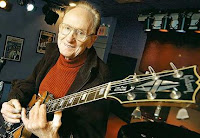
Les figured out that if you put two recording heads side by side, they could record two different tracks on the same piece of tape. Before long he and his wife, Mary Ford, were making recordings in their home using nothing but his guitar and her voice. Amazing recordings, rich in tone, timbre, and harmony. On the road, they didn't need a band. Just a copy of the backing tape. Throughout the late '40's and early '50's they produced hit after hit.
Les was also an innovator of guitar construction. He had the idea for a solid-body electric years before anybody was making them. He tried for years to get Gibson to listen to him. They refused, until Leo Fender's Telecaster came out. Then, all of a sudden, it seemed like a pretty good idea after all. To this day, a Gibson Les Paul model is one of the most coveted guitars.
But after all that, you've got to sit down and listen to the man play. And damn, could he play! Still does, in fact. At this writing, he just turned 92. He still has a gig every Monday night at a club in New York City, and everybody who's anybody drops by to listen, and maybe even jam a little. Les had - and has - that wonderful combination of technique and flash that makes his music irresistable.
Next up; Chet Atkins. Quite simply, this man has influenced the playing of practically everybody who's followed him. What is most surprising about that is that he did not come from the world of Classical music, or even Jazz, but Country-Western. Classical, and nowadays Jazz, get studied in college. Country, on the other hand, is now and has always been a music of the people. In spite of this, or maybe because of it, Chet has without a doubt influenced more guitarists than anyone who ever lived.
A brief history of fingerstyle country guitar goes sort of like this; in the beginning was Mother Maybelle. "Can The Circle Be Unbroken" is only one of the many famous songs Maybelle Carter wrote for the Carter Family. In the '20's and '30's, she, husband A. P. Carter, and her siblings - and later, her daughters - would harmonize, often accompanied by nothing more than Maybelle's guitar.
She had a unique style for the day. She would play a melody on the bass strings with her thumb, and in counterpoint strum chords on the upper strings with her fingers. It was a simple style that created a lot of music. The great Merle Travis turned the idea on its head by playing alternating bass notes with his thumbs and countering with arpeggios and melodies on the treble strings with his fingers.
These two greats by no means invented fingerstyle guitar, however. It was the standard way to play Classical guitar and lute, long before Segovia came along. But most Jazz, Country, and other "folk" musicians strummed with a plectrum. Mother Maybelle and Merle helped bring a new level of harmonic and rhythmic sophistication to their music.
Enter one Chester Atkins. As a young man he was hungry to improve his playing, and so he began studying Classical guitar. And yet, instead of becoming a Classical guitarist, he brought what he learned back to the music he loved. This as much as anything about Chet proved to be a huge influence on all who followed him. Nowadays it's common for musicians to cross the lines between styles. In Chet's day, it was considered a pretty radical thing to do.
Chet went on to become A&R Chief for RCA records, as well as the label's senior producer. In this role he literally set the standards for country music for decades. He is the man we can thank - or blame - for bringing country music uptown. He is the reason that the best musicians and songwriters can now be found in Nashville.
Toward the end of his life as he began to step away from the business end he returned to his first love; the guitar. He recorded a number of duet albums with musicians he admired, including Merle Travis, Mark Knopfler, and two grammy-winning collaborations with Les Paul. He was practically a regular on the Prairie Home Companion radio show.
 The final guitarist on my list is none other than James Marshall Hendrix. Like Charlie Christian, his life and career were cut short. And, like Charlie Christian, he forever changed the way that guitarists approach their instrument.
To me, the basic idea behind Hendrix' style is that of the electric guitar as an orchestra. He would find a new sound in his instrument and figure out how to add it to his palette of colors. To him, the guitar wasn't just a part of the band. He truly believed that with a bass player and a drummer he could play anything he wanted.
The key ingredients were volume and electronic processing. As Metal instrumentalist Steve Vai has pointed out, "volume IS tone." The more you turn your amplifier up, the more possibilities you open up. The slightest touch to the guitar makes sounds, and he used them all. He would lightly brush the strings, tap on the body and back of the neck, play with the strings above the nut, work the switches and potentiometers while he played, and generally use everything he could find.
To all this mechanical manipulation he added the ever-growing line-up of effects pedals that were being invented in the 1960's. Wah pedals, phase shifters, flanging, echo, reverbs, delays, octave dividers, leslie cabinets, whatever anybody came up with to alter the signal, he'd give it a try. Experience Bassist Noel Redding told of the frustration he'd feel when somebody came to the studio with a new toy. Instead of working on the song, Jimi would start exploring the latest gadget. He and drummer Mitch Mitchell would leave, have lunch, hang out, go shopping, and when they came back a few hours later Jimi was still at it with that same toy.
To most guitarists before him, feedback was something to be avoided at all costs. He learned how to conjure it and play it. He showed all of us guitarists that there's more to our instrument than melody, harmony, and rhythm. When Adrian Belew imitates elephant shouts, he's following Hendrix. Same with Sonny Landreth when he plucks behind the slide. And Kaki King, when she explores the sonic boundries of her Ovation acoustic. Or Eddie Van Halen when he dive-bombs with his whammy bar. All hail, King Jimi.
At the time of his death at the age of 27, Jimi was preparing to do a recording session with Gil Evans and a small orchestra. This is the same Gil Evans that Miles Davis recorded three of his most highly acclaimed albums with. Jimi was looking at ways to go beyond what was expected from him as a popular musician, and not just as a guitarist. His compositions were getting longer and more complex. You can see it in Electric Ladyland, Band Of Gypsies, and the recordings that the family has released as First Dawn Of The New Rising Sun.
There. Whew. Finally glad to get that off my chest. Let the debate begin.
Tuesday, July 03, 2007
My favorite music stores
As a public service, this is about a handful of music stores I think it would be worth your while to check out. Remember that I live in central New Hampshire, so all the stores are in that general area. Also remember that I am a guitar player, so the list leans heavily to that end of things.
Also, you should know that I'm not a big fan of big music stores. Although from time to time I do business in them, I never really feel at home in them. It's rare to find one that really knows a lot about everything they have in stock. If you want an electric guitar, you'd better want a Strat or a Les Paul or nobody's going to be able to answer your questions. On the other hand, a good small store with a few product lines can usually give you intelligent answers about everything in the store.
These are laid out in roughly geographic order, from South to North. No other ranking should be implied.
WORKING CLASS MUSIC, Tilton, NH.
Link: http://www.workingclassmusic.com/
This is where just about all of my PA gear has come from for the last ten years. Greg is the owner, and he's a good guy. A little terse sometimes, but straightforward and honest. You may not like everything he says, but you can take it to the bank. Working Class is a long-time Peavey dealer, and if I had to buy anything musical on name alone, I'd lean heavily to Peavey. Their stuff always sounds at least pretty good, and often damn good, and it's tough as nails. Greg's also got a good selection of reasonably priced guitars, which often includes some real gems. He always seems to have a couple of inexpensive Stratocasters I wish I could buy.
They actually have a website again, although Greg's never relied much on the internet for his business. He's notoriously bad about answering his emails, so call him on the phone. He's also got a selection of hand-made jewelry.
VINTAGE FRET SHOP, Ashland, NH
Link: http://www.vintagefret.com/
Dave Coburn is a figure of almost mythic proportions to the local music community. To be sure, some people are disdainful of VFS and Dave. In part, because he's not afraid to ask what he really thinks a piece is worth, and then let it hang there until he gets his price. But also, because he sets the standard for small music stores in New Hampshire. Everybody at some time or another bends the knee to Dave. He's done it all, and still stands head and shoulders above the rest. Most of the proprietors on this list think of Dave as a friend, and even a mentor.
The famous profile of Dave that is the icon of the store shows him with the long beard that he actually hasn't worn in years. I've known him, and shopped with him, since before he could grow it. His store on Riverside Drive in Ashland is a treasure trove of fine fretted instruments, although if you're on a budget he's got something for you as well. His long suit is acoustic guitars, and VFS sells both Martin and Taylor flattops. He's also a Fender dealer, and there's always a bunch of lust-worthy electrics hanging on the walls.
They've also got a world-class repair facility. Yes, Scott thinks everything he touches becomes worth its weight in gold, but he gets away with it because he's very, very good at what he does. I've learned over the years to only ask once what a repair will cost, because every time you ask, the price goes up. You can trust, however, that if you put your precious axe in their hands it will be treated right.
DAVE ALLBEE, Main Street, North Haverhill, NH
Phone: 603-787-6196
Dave doesn't have a website that I'm aware of. I don't even know if he's got an email address. What he does have is magic hands. He is my repair guy of choice. I'm also proud to be able to call him my friend. Even if I have nothing to fix, I try and make it a point to stop by and swap stories with him from time to time.
The biggest thing I ever threw at him was my Guild dreadnaught. It's a 1969 D44 with pearwood back and sides, and it got rather unceremoniously dropped on its heel a number of years ago. Half a dozen good repair people had me convinced that I'd never play it again. One said they'd use the neck and put on another top, back, and sides. Another said they could fix it, but it would cost $1500. Everybody else said simply not to bother.
When Dave saw it, he looked it all over real good. Then, he described step by step how he would fix it. When he'd finished, he quoted me a price of $200. I left it with him. A month later, I picked it up. That was three years ago, and I'm still playing it. The man's a genius, I tell ya. I saw him take an Epiphone ES335 copy with a badly warped neck and straighten it out. I don't care what it is you need fixed, you owe it to yourself to at least let Dave take a look at it.
He also buys and sells various used instruments. He's got a nice selection of acoustic and electric guitars, mandolins, fiddles, and you can even get the standard accessories there; strings, picks, tuners, cables, etc. He works out of his house, so it's pretty casual. You catch him at home and he's open. His place is just north of the N. Haverhill town building on main street. When you stop in, tell him I said hi.
NORTHERN LIGHTS, Littleton, NH
Link: http://www.northernlightsmusic.com/
Dan Soloman's the principal dude here. Brilliant musician, and a super nice guy. He built this place up from a hole in the wall with his own instruments into one of the North country's premier music shops. He's got a big acoustic guitar room, stocked with shiny new Taylors. The main part of the store has two walls full of a variety of electrics. But the room that knocks me out is the electric room, stuffed to the gunnalls with the best that Fender, Gretsch, etc. have to offer, and lined with shiny new amps.
He's also got keyboards, effects, sheet music, damn, the place has everything. And he's even reasonably priced! Recently, a friend of mine was interested in purchasing a hollow-body electric guitar. We went to a big-name store in the Southern part of the state, found what he wanted, and got the salesman down to his rock-bottom price. They were just about to close the deal, and I pulled my friend aside. I told him that Dan had the identical guitar hanging on his wall for fifty bucks less. The salesman scoffed.
Buddy, if you're reading this, I wasn't kidding, and you blew a sale. Bob loves his new Gretsch, and he really loves the deal Dan gave him. Tempus fugit.
FRIENDLY RIVER MUSIC, Cornish, ME.
Link: http://www.friendlyrivermusic.com/index.htm
I'm tempted to name this place my new favorite, even though I've only been there once. I was absolutely flabbergasted by the selection of guitars and amps this place had. And, it's all housed in a barn attached to a house on a side street near the river in Cornish, Maine. If not for the classy hand-carved sign in the front yard, you'd never know it was there. A hidden treasure, to be sure.
Let's start with the wall full of classic Fenders, Gretschs, Gibsons, Martins, Taylors, and anything else your pit-pattering heart can imagine. On top of that he also sells new Fenders and Taylors. Then, we go to the amps. Fender, Rivera, and Orange amps dominate the floor, including a really sweet collection of old Champs. Yes, he's got some inexpensive stuff, but he's a firm believer in quality. We talked for an hour about amp cabinets, and why he likes real plywood over particle board. "Would you make a solidbody guitar out of particle board?"
From the lakes region of New Hampshire, take US rt. 25 to Maine, stay on 25, and when you get to Cornish keep an eye out for a nondescript sign on the left directing you down a side street. Hint for first-time visitors: Ask to see the Hunt Tele. You won't believe your eyes, or your fingers. And, be sure you check the hours before you go. He's got a day job, and if you get there in the early afternoon you're out of luck.
GREEN MOUNTAIN GUITARS, Bradford, VT
Link: http://www.greenmountainguitars.com/
This is not a music store, but Glen DeRusha makes the best acoustic guitars I've ever played, so I'm giving him a shout-out. His workshop is in his garage. Open his website and you'll immediately hear one of his guitars. He builds them one at a time, and he seems determined to price his guitars below those of every other boutique luthier in the world. It's a case of getting way more than you pay for. You owe it to yourself to go to his house, accept his gracious hospitality, and bless your fingers with one of his git-fiddles. You'll never forget it. For myself, I've been talking to him about building me a 12-string.
'Nuff for now. Keep on rockin'.
Also, you should know that I'm not a big fan of big music stores. Although from time to time I do business in them, I never really feel at home in them. It's rare to find one that really knows a lot about everything they have in stock. If you want an electric guitar, you'd better want a Strat or a Les Paul or nobody's going to be able to answer your questions. On the other hand, a good small store with a few product lines can usually give you intelligent answers about everything in the store.
These are laid out in roughly geographic order, from South to North. No other ranking should be implied.
WORKING CLASS MUSIC, Tilton, NH.
Link: http://www.workingclassmusic.com/
This is where just about all of my PA gear has come from for the last ten years. Greg is the owner, and he's a good guy. A little terse sometimes, but straightforward and honest. You may not like everything he says, but you can take it to the bank. Working Class is a long-time Peavey dealer, and if I had to buy anything musical on name alone, I'd lean heavily to Peavey. Their stuff always sounds at least pretty good, and often damn good, and it's tough as nails. Greg's also got a good selection of reasonably priced guitars, which often includes some real gems. He always seems to have a couple of inexpensive Stratocasters I wish I could buy.
They actually have a website again, although Greg's never relied much on the internet for his business. He's notoriously bad about answering his emails, so call him on the phone. He's also got a selection of hand-made jewelry.
VINTAGE FRET SHOP, Ashland, NH
Link: http://www.vintagefret.com/
Dave Coburn is a figure of almost mythic proportions to the local music community. To be sure, some people are disdainful of VFS and Dave. In part, because he's not afraid to ask what he really thinks a piece is worth, and then let it hang there until he gets his price. But also, because he sets the standard for small music stores in New Hampshire. Everybody at some time or another bends the knee to Dave. He's done it all, and still stands head and shoulders above the rest. Most of the proprietors on this list think of Dave as a friend, and even a mentor.
The famous profile of Dave that is the icon of the store shows him with the long beard that he actually hasn't worn in years. I've known him, and shopped with him, since before he could grow it. His store on Riverside Drive in Ashland is a treasure trove of fine fretted instruments, although if you're on a budget he's got something for you as well. His long suit is acoustic guitars, and VFS sells both Martin and Taylor flattops. He's also a Fender dealer, and there's always a bunch of lust-worthy electrics hanging on the walls.
They've also got a world-class repair facility. Yes, Scott thinks everything he touches becomes worth its weight in gold, but he gets away with it because he's very, very good at what he does. I've learned over the years to only ask once what a repair will cost, because every time you ask, the price goes up. You can trust, however, that if you put your precious axe in their hands it will be treated right.
DAVE ALLBEE, Main Street, North Haverhill, NH
Phone: 603-787-6196
Dave doesn't have a website that I'm aware of. I don't even know if he's got an email address. What he does have is magic hands. He is my repair guy of choice. I'm also proud to be able to call him my friend. Even if I have nothing to fix, I try and make it a point to stop by and swap stories with him from time to time.
The biggest thing I ever threw at him was my Guild dreadnaught. It's a 1969 D44 with pearwood back and sides, and it got rather unceremoniously dropped on its heel a number of years ago. Half a dozen good repair people had me convinced that I'd never play it again. One said they'd use the neck and put on another top, back, and sides. Another said they could fix it, but it would cost $1500. Everybody else said simply not to bother.
When Dave saw it, he looked it all over real good. Then, he described step by step how he would fix it. When he'd finished, he quoted me a price of $200. I left it with him. A month later, I picked it up. That was three years ago, and I'm still playing it. The man's a genius, I tell ya. I saw him take an Epiphone ES335 copy with a badly warped neck and straighten it out. I don't care what it is you need fixed, you owe it to yourself to at least let Dave take a look at it.
He also buys and sells various used instruments. He's got a nice selection of acoustic and electric guitars, mandolins, fiddles, and you can even get the standard accessories there; strings, picks, tuners, cables, etc. He works out of his house, so it's pretty casual. You catch him at home and he's open. His place is just north of the N. Haverhill town building on main street. When you stop in, tell him I said hi.
NORTHERN LIGHTS, Littleton, NH
Link: http://www.northernlightsmusic.com/
Dan Soloman's the principal dude here. Brilliant musician, and a super nice guy. He built this place up from a hole in the wall with his own instruments into one of the North country's premier music shops. He's got a big acoustic guitar room, stocked with shiny new Taylors. The main part of the store has two walls full of a variety of electrics. But the room that knocks me out is the electric room, stuffed to the gunnalls with the best that Fender, Gretsch, etc. have to offer, and lined with shiny new amps.
He's also got keyboards, effects, sheet music, damn, the place has everything. And he's even reasonably priced! Recently, a friend of mine was interested in purchasing a hollow-body electric guitar. We went to a big-name store in the Southern part of the state, found what he wanted, and got the salesman down to his rock-bottom price. They were just about to close the deal, and I pulled my friend aside. I told him that Dan had the identical guitar hanging on his wall for fifty bucks less. The salesman scoffed.
Buddy, if you're reading this, I wasn't kidding, and you blew a sale. Bob loves his new Gretsch, and he really loves the deal Dan gave him. Tempus fugit.
FRIENDLY RIVER MUSIC, Cornish, ME.
Link: http://www.friendlyrivermusic.com/index.htm
I'm tempted to name this place my new favorite, even though I've only been there once. I was absolutely flabbergasted by the selection of guitars and amps this place had. And, it's all housed in a barn attached to a house on a side street near the river in Cornish, Maine. If not for the classy hand-carved sign in the front yard, you'd never know it was there. A hidden treasure, to be sure.
Let's start with the wall full of classic Fenders, Gretschs, Gibsons, Martins, Taylors, and anything else your pit-pattering heart can imagine. On top of that he also sells new Fenders and Taylors. Then, we go to the amps. Fender, Rivera, and Orange amps dominate the floor, including a really sweet collection of old Champs. Yes, he's got some inexpensive stuff, but he's a firm believer in quality. We talked for an hour about amp cabinets, and why he likes real plywood over particle board. "Would you make a solidbody guitar out of particle board?"
From the lakes region of New Hampshire, take US rt. 25 to Maine, stay on 25, and when you get to Cornish keep an eye out for a nondescript sign on the left directing you down a side street. Hint for first-time visitors: Ask to see the Hunt Tele. You won't believe your eyes, or your fingers. And, be sure you check the hours before you go. He's got a day job, and if you get there in the early afternoon you're out of luck.
GREEN MOUNTAIN GUITARS, Bradford, VT
Link: http://www.greenmountainguitars.com/
This is not a music store, but Glen DeRusha makes the best acoustic guitars I've ever played, so I'm giving him a shout-out. His workshop is in his garage. Open his website and you'll immediately hear one of his guitars. He builds them one at a time, and he seems determined to price his guitars below those of every other boutique luthier in the world. It's a case of getting way more than you pay for. You owe it to yourself to go to his house, accept his gracious hospitality, and bless your fingers with one of his git-fiddles. You'll never forget it. For myself, I've been talking to him about building me a 12-string.
'Nuff for now. Keep on rockin'.
Monday, April 16, 2007
A couple more Rough Edges tracks
Well, there's a couple more copies of Rough Edges out in the world, so I might as well get on with the business of doing the liner notes. Tonight, I'll tell you about tracks three and four.
3 - The Train Song
This was inspired in part by the 13th chapter of First Corinthians, but the musical form came from a TV show I was watching on PBS one night. It featured a group of women folk singers, and included the Indigo Girls, Holly Near, and several others. I liked the way the songs tended to be put together. I especially liked the light touch they used to get their points across. It was gentle, thoughtful music and so much of mine at the time seemed heavy-handed in comparison.
It's in a standard tuning, but capoed on the third fret. The little opening theme is from Elizabeth Cotten's "Freight Train," so credit where credit is due. I couldn't resist putting it there. I hope Ms. Cotten's estate will be satisfied with a small percentage of the vast profits I've realized off the six or seven copies I've sold so far. ;>
4 - Speaking In Tongues
The long title for this is "My Fingers are Speaking in Tongues." Lyrically speaking, it's pretty self-explainatory. The music came from a warm-up exercise I came up with that makes use of a lot of 'tone clusters.' That's where you take a chord form usually used in the first three frets of the guitar and shove them up and down the neck. Cool stuff.
Both of these songs differ from most of this collection, in that they were recorded at New Sherriff Studios in Laconia, NH. I believe this facility is now defunct, as the Sherriff, one Dave Marsh, has left the area. Too bad. Very generous and talented guy. He was part of a three-piece project called MD2, which put out one CD. Musically, it's kind of in a little grey area that resides between New Age, mellow Techno, and soft jazz. It was a sax player, a percussionist, and Dave on electronic stuff. He helped turn Greenlaw's Music in Laconia back into a serious music store. Anyway, I recorded these two songs and the opener, "The Ballad of Bilbo Baggins," at his place.
3 - The Train Song
This was inspired in part by the 13th chapter of First Corinthians, but the musical form came from a TV show I was watching on PBS one night. It featured a group of women folk singers, and included the Indigo Girls, Holly Near, and several others. I liked the way the songs tended to be put together. I especially liked the light touch they used to get their points across. It was gentle, thoughtful music and so much of mine at the time seemed heavy-handed in comparison.
It's in a standard tuning, but capoed on the third fret. The little opening theme is from Elizabeth Cotten's "Freight Train," so credit where credit is due. I couldn't resist putting it there. I hope Ms. Cotten's estate will be satisfied with a small percentage of the vast profits I've realized off the six or seven copies I've sold so far. ;>
4 - Speaking In Tongues
The long title for this is "My Fingers are Speaking in Tongues." Lyrically speaking, it's pretty self-explainatory. The music came from a warm-up exercise I came up with that makes use of a lot of 'tone clusters.' That's where you take a chord form usually used in the first three frets of the guitar and shove them up and down the neck. Cool stuff.
Both of these songs differ from most of this collection, in that they were recorded at New Sherriff Studios in Laconia, NH. I believe this facility is now defunct, as the Sherriff, one Dave Marsh, has left the area. Too bad. Very generous and talented guy. He was part of a three-piece project called MD2, which put out one CD. Musically, it's kind of in a little grey area that resides between New Age, mellow Techno, and soft jazz. It was a sax player, a percussionist, and Dave on electronic stuff. He helped turn Greenlaw's Music in Laconia back into a serious music store. Anyway, I recorded these two songs and the opener, "The Ballad of Bilbo Baggins," at his place.
Saturday, March 24, 2007
Rory Gallagher
http://www.rorygallagher.com/

One of my favorite guitarists, and one of my biggest influences on the instrument, is Rory Gallagher. A bluesman from Ireland, he's not very well known in the US, but he was a big star in Europe.
I first heard Rory back in the mid-seventies. I had a friend named Barry Sutton who turned me on to a lot of great music. I was just starting to get serious about playing the guitar, and Barry changed my point of view forever by playing me "Irish Tour '74." At that time Jimi Hendrix was the center of the guitar universe. You were either trying to sound like him (Robin Trower, Frank Marino) or you were going in completely the opposite direction (Steve Howe, John McLaughlin). You have to remember, this was a pre-Van Halen/Stevie Ray world.
Rory was the anti-Hendrix. I was, and am, a big Hendrix fan, but Rory's approach was so breathtakingly fresh that I couldn't resist. Like a lot of other players at the time, I was busy filling the floor with effects pedals. My biggest mistake was to get a pretty good guitar and a pretty good amp, and then try and make them sound better with stomp boxes. Fuzz, flange, phase, compression, you name it and I had it parked a toe-tap away.
In contrast, Rory's rig at the time was dirt-simple; a Stratocaster, a Fender Twin Reverb amp, and a cable. That's it. And man, he could make that thing talk! Lately I've been digging through my collection and his albums hold up well over the passage of time. They don't sound the least bit dated. On the contrary, they prove the staying power of good ol' straightforward blues-rock.
Recommended titles? Just about anything is going to be a treat, but the older stuff has questionable production values, and some of the later stuff is a little over-the-top. I'd recommend starting with Irish Tour '74, the best of his three live albums. Live In Europe from '71 is a little more blues-centric, and his 1980 Stagestruck shows him in an almost heavy metal mood.
My favorite album of his is the studio effort from 1975, Against the Grain. I'd also point out Top Priority from '79, and Tattoo circa '73. These are the best-sounding recordings, and the quality of the songs is among his best. There are also some very good live DVDs out there, including a video record of the aforementioned Irish tour, and a new 2-disc set taken from his five appearances at the Montreaux Jazz Festival.
For a longtime Rory fan, Live At Montreaux is a little disturbing. News of Rory had always been a little spotty, and you get to see how his life progressed as well as his music. Sadly, he died in 1995 of complications from a liver transplant. That tells a lot of the story right there. His life apparently revolved around three things; playing the guitar, chasing the skirts, and drinking. From what I've heard he actually had the liver transplant around 1990. For a couple of years he took a little better care of himself, but eventually settled back into his old ways.
The Rory Gallagher we see from his 1994 set is a heavier, sadder man than the one who jammed with jazz great Larry Coryell in 1975. He used to have either two or three pieces behind him, but here he had at least five, and brought on Bela Fleck for a couple of tunes. He smiled, but still looked sad. He and the band took a leisurly stroll through the tunes, playing with convuluted endings and aimless solos. And still, every now and then, the brilliant strat-master would occasionally peek through, showing flashes of not just the old brilliance, but actual growth as an artist. At 47, the only thing he'd lost was his reason to live. He'd done it all, and simply didn't know what to do next.
His brother and manager, Donal, keeps the flame alive. There's an excellent website, the link for which is above. Interest in his music keeps most of his catalogue in print, so while it might take some detective work to actually find his CD's, it's certainly not impossible. If you like good rock guitar playing and feel like some get-down kick-ass rock and roll, you owe it to yourself to give Rory a listen.

One of my favorite guitarists, and one of my biggest influences on the instrument, is Rory Gallagher. A bluesman from Ireland, he's not very well known in the US, but he was a big star in Europe.
I first heard Rory back in the mid-seventies. I had a friend named Barry Sutton who turned me on to a lot of great music. I was just starting to get serious about playing the guitar, and Barry changed my point of view forever by playing me "Irish Tour '74." At that time Jimi Hendrix was the center of the guitar universe. You were either trying to sound like him (Robin Trower, Frank Marino) or you were going in completely the opposite direction (Steve Howe, John McLaughlin). You have to remember, this was a pre-Van Halen/Stevie Ray world.
Rory was the anti-Hendrix. I was, and am, a big Hendrix fan, but Rory's approach was so breathtakingly fresh that I couldn't resist. Like a lot of other players at the time, I was busy filling the floor with effects pedals. My biggest mistake was to get a pretty good guitar and a pretty good amp, and then try and make them sound better with stomp boxes. Fuzz, flange, phase, compression, you name it and I had it parked a toe-tap away.
In contrast, Rory's rig at the time was dirt-simple; a Stratocaster, a Fender Twin Reverb amp, and a cable. That's it. And man, he could make that thing talk! Lately I've been digging through my collection and his albums hold up well over the passage of time. They don't sound the least bit dated. On the contrary, they prove the staying power of good ol' straightforward blues-rock.
Recommended titles? Just about anything is going to be a treat, but the older stuff has questionable production values, and some of the later stuff is a little over-the-top. I'd recommend starting with Irish Tour '74, the best of his three live albums. Live In Europe from '71 is a little more blues-centric, and his 1980 Stagestruck shows him in an almost heavy metal mood.
My favorite album of his is the studio effort from 1975, Against the Grain. I'd also point out Top Priority from '79, and Tattoo circa '73. These are the best-sounding recordings, and the quality of the songs is among his best. There are also some very good live DVDs out there, including a video record of the aforementioned Irish tour, and a new 2-disc set taken from his five appearances at the Montreaux Jazz Festival.
For a longtime Rory fan, Live At Montreaux is a little disturbing. News of Rory had always been a little spotty, and you get to see how his life progressed as well as his music. Sadly, he died in 1995 of complications from a liver transplant. That tells a lot of the story right there. His life apparently revolved around three things; playing the guitar, chasing the skirts, and drinking. From what I've heard he actually had the liver transplant around 1990. For a couple of years he took a little better care of himself, but eventually settled back into his old ways.
The Rory Gallagher we see from his 1994 set is a heavier, sadder man than the one who jammed with jazz great Larry Coryell in 1975. He used to have either two or three pieces behind him, but here he had at least five, and brought on Bela Fleck for a couple of tunes. He smiled, but still looked sad. He and the band took a leisurly stroll through the tunes, playing with convuluted endings and aimless solos. And still, every now and then, the brilliant strat-master would occasionally peek through, showing flashes of not just the old brilliance, but actual growth as an artist. At 47, the only thing he'd lost was his reason to live. He'd done it all, and simply didn't know what to do next.
His brother and manager, Donal, keeps the flame alive. There's an excellent website, the link for which is above. Interest in his music keeps most of his catalogue in print, so while it might take some detective work to actually find his CD's, it's certainly not impossible. If you like good rock guitar playing and feel like some get-down kick-ass rock and roll, you owe it to yourself to give Rory a listen.
Wednesday, March 21, 2007
A couple more songs
5 - The Painter's Song
My brother, Rett, is a painter. We've always had sort of a mutual admiration society between us, because I wish I could paint, and he wishes he could play music. I am also a huge fan of his painting, and have many examples of his work hanging in my house.
Every fall Plymouth, NH has an art show on its town common. I've managed to get to several of these events over the years, and I get a big kick out of it. The one problem I have with it is that it's kind of landscape overkill. Nothing wrong with a good landscape, but when you've got fifty or seventy-five painters showing their work, and the vast majority of them are showing New England landscapes, it gets to be a bit much. I don't blame them, because that's what sells, but after a while they all sort of run together.
So, I usually end up finding that one painter that is doing something radically different. This song was inspired by a fellow whose name I'm afraid I've forgotten, but I'll never forget his art. I could go on and on about it, but suffice to say it was very striking. This song was inspired by a trilogy of paintings he'd done, two of which he still had. All together I think it referred to the twilight of the gods. One was of a small group of Norse gods looking like the morning end of an all-night drunk. The other appeared at first to be little more than swirls of brown and beige color, but on closer examination was a mass of nude bodies all mingled together. Very striking.
6 - Heroes
This one was written as I was reading "Taliesin" by Stephen Lawhead. He spent a couple of years in the British Isles researching the Arthur legends, and in the end got four books written. Personally, they're my favorite telling of the tales.
One of the core ideas that's always in the back of my mind is that everyone has greatness within them. I believe that with all of my heart. Too few people in this world are willing to truly make the effort to try and live up to their own ideals. It's like Albert King used to say; everybody wants to go to heaven, but nobody wants to die.
As a Christian, the example I try and follow is that of Christ, but of course I have much more than his example to follow. That's the advantage the Christian has. Whatever it is that you are into or believe in, you owe it to yourself to set yourself aside and follow that which you believe is the core of true faith. Find out if it works, dammit. Use yourself and your life as a laboratory. Then, you can speak about it with authority.
For myself, I have put Christ, His spirit and His word to the test for 23 years and counting, and my life has progressed. I have tried to follow the hero's path. Not very well, I'll grant you; lots of mistakes and failures, but then again I don't feel like I've missed anything. There are things I know I've needed to do, and by God they've gotten done, or at least attempted. Who could ask for more?
My brother, Rett, is a painter. We've always had sort of a mutual admiration society between us, because I wish I could paint, and he wishes he could play music. I am also a huge fan of his painting, and have many examples of his work hanging in my house.
Every fall Plymouth, NH has an art show on its town common. I've managed to get to several of these events over the years, and I get a big kick out of it. The one problem I have with it is that it's kind of landscape overkill. Nothing wrong with a good landscape, but when you've got fifty or seventy-five painters showing their work, and the vast majority of them are showing New England landscapes, it gets to be a bit much. I don't blame them, because that's what sells, but after a while they all sort of run together.
So, I usually end up finding that one painter that is doing something radically different. This song was inspired by a fellow whose name I'm afraid I've forgotten, but I'll never forget his art. I could go on and on about it, but suffice to say it was very striking. This song was inspired by a trilogy of paintings he'd done, two of which he still had. All together I think it referred to the twilight of the gods. One was of a small group of Norse gods looking like the morning end of an all-night drunk. The other appeared at first to be little more than swirls of brown and beige color, but on closer examination was a mass of nude bodies all mingled together. Very striking.
6 - Heroes
This one was written as I was reading "Taliesin" by Stephen Lawhead. He spent a couple of years in the British Isles researching the Arthur legends, and in the end got four books written. Personally, they're my favorite telling of the tales.
One of the core ideas that's always in the back of my mind is that everyone has greatness within them. I believe that with all of my heart. Too few people in this world are willing to truly make the effort to try and live up to their own ideals. It's like Albert King used to say; everybody wants to go to heaven, but nobody wants to die.
As a Christian, the example I try and follow is that of Christ, but of course I have much more than his example to follow. That's the advantage the Christian has. Whatever it is that you are into or believe in, you owe it to yourself to set yourself aside and follow that which you believe is the core of true faith. Find out if it works, dammit. Use yourself and your life as a laboratory. Then, you can speak about it with authority.
For myself, I have put Christ, His spirit and His word to the test for 23 years and counting, and my life has progressed. I have tried to follow the hero's path. Not very well, I'll grant you; lots of mistakes and failures, but then again I don't feel like I've missed anything. There are things I know I've needed to do, and by God they've gotten done, or at least attempted. Who could ask for more?
Sunday, March 11, 2007
More Rough Edges notes
7 - Prophet Sharing
This is a two-parter, written around 1989-1990. I spent the better part of a month parked on my couch with a back injury so I took the time to do some bible study. I headed for the minor prophets and got particularly interested in the book of Joel. The first half of this song is a rough paraphrase of Joel. I've noted that the old testament prophets were particularly fond of proclaiming woe; oh, woe unto thee, though stiff-necked and badly-dressed people. And so, the first half of this song is called "Woe, Nellie."
The second half is an extrapolation of the first half's warnings into the modern day. If you read Joel, he has a lot to say to us. About that time I learned that the word "secular" does not mean simply "without God" as I once thought, but instead "in the world." There's a lot of talk in Evangelical circles, and the contemporary Christian music community, about secularism. If this world truly belongs to Satan, then I am a spy for the other side.
This was one of the recordings that was hardest to include, and hardest to leave off. I'm particularly proud of this song (I suppose I should say, grateful) but am definitely not satisfied with the recording. I've been known to do it as a solo acoustic piece, but there's been a couple of opportunities to play it live with a band, and it comes off much better. Someday I'd like to record it that way.
8 - The Promise
This was written for a young man I knew who was having a very serious crisis of faith. I guess I offer it up as a prayer on his behalf. I'm pleased to report that, the last I knew, he was walking the walk.
As for the musical construction, this one's written on a guitar tuned to DADGAD. It's a tuning that Martin Carthy developed to help him better interperet Irish music for the guitar. The fingerstyle master Pierre Bensusan uses it a lot, as did the late Michael Hedges. With endorsements like that, how could I resist?
9 - A Voice
Pretty self-explanatory, lyrically. Musically, it's an acoustic guitar capoed on the fifth fret. I like the sound of it up there.
10 - Up
This was more or less an experiment to see what I could do with the sequencer and some tape speed adjustments. It's also some serious thought on the state of the world today.
11 - Wheels
This is one of my wife, Lynn's favorites. She especially likes the two overlapping synth patterns. This one's a tough one to do live, but we always have a lot of fun with it. Without the sequencer, I instead do a slapback-echo thing on the guitar, a la Edge of U2. Oftimes, the end of the song turns into an extended jam. Still, I think I prefer this version.
This is a two-parter, written around 1989-1990. I spent the better part of a month parked on my couch with a back injury so I took the time to do some bible study. I headed for the minor prophets and got particularly interested in the book of Joel. The first half of this song is a rough paraphrase of Joel. I've noted that the old testament prophets were particularly fond of proclaiming woe; oh, woe unto thee, though stiff-necked and badly-dressed people. And so, the first half of this song is called "Woe, Nellie."
The second half is an extrapolation of the first half's warnings into the modern day. If you read Joel, he has a lot to say to us. About that time I learned that the word "secular" does not mean simply "without God" as I once thought, but instead "in the world." There's a lot of talk in Evangelical circles, and the contemporary Christian music community, about secularism. If this world truly belongs to Satan, then I am a spy for the other side.
This was one of the recordings that was hardest to include, and hardest to leave off. I'm particularly proud of this song (I suppose I should say, grateful) but am definitely not satisfied with the recording. I've been known to do it as a solo acoustic piece, but there's been a couple of opportunities to play it live with a band, and it comes off much better. Someday I'd like to record it that way.
8 - The Promise
This was written for a young man I knew who was having a very serious crisis of faith. I guess I offer it up as a prayer on his behalf. I'm pleased to report that, the last I knew, he was walking the walk.
As for the musical construction, this one's written on a guitar tuned to DADGAD. It's a tuning that Martin Carthy developed to help him better interperet Irish music for the guitar. The fingerstyle master Pierre Bensusan uses it a lot, as did the late Michael Hedges. With endorsements like that, how could I resist?
9 - A Voice
Pretty self-explanatory, lyrically. Musically, it's an acoustic guitar capoed on the fifth fret. I like the sound of it up there.
10 - Up
This was more or less an experiment to see what I could do with the sequencer and some tape speed adjustments. It's also some serious thought on the state of the world today.
11 - Wheels
This is one of my wife, Lynn's favorites. She especially likes the two overlapping synth patterns. This one's a tough one to do live, but we always have a lot of fun with it. Without the sequencer, I instead do a slapback-echo thing on the guitar, a la Edge of U2. Oftimes, the end of the song turns into an extended jam. Still, I think I prefer this version.
Subscribe to:
Posts (Atom)