
Wednesday, February 06, 2013

Carlos!


It’s kind of difficult to break the Santana band’s catalog down into particular eras.  Musically, the elements present on their first album in 1969 are intact on their latest release; lots of Latin percussion, and Carlos’ guitar.  Their musical journey has been evolutionary, with those two factors as the constants of their universe.

The clearest break in their history was the departure of Greg Rolie and Neal Schon after their fourth album, Caravanserai.  That represented probably the most radical change in the band’s sound, and many would say that they’ve never been as good.  Their first three albums especially had a fire and a raw energy that few if any of their later releases possessed.

As a package, these first three albums are an interesting study, especially taken in light of the ’97 release of their ’68 live set at the Fillmore, along with their famous performance at the Woodstock festival.  On the Fillmore album they are young and raw, still finding their way.  By Woodstock, only about a year later, they were much tighter and the songs much more fleshed out.  The first album hadn’t even been released yet, but the incendiary footage of “Soul Sacrifice” put “Santana I” high on the chart.

Still, this first album, as hot as it was, only showed their potential.  The second, Abraxas, was better, and the third album arguably better still.  Among Santana fans, the debate will surely rage until the Second Coming whether Abraxas or III was the better album.  Some say Abraxas was too raw, others that III was too slick and too mellow.  I’m still deciding, so please put them both back in the CD player, thank you.


Now, it is widely known that the band were using a lot of, ahem, recreational chemical enhancement during this period.  Carlos has admitted in print that he was very, very high during the Woodstock set and alleges to not remember a lot of the details.  He has been quite unapologetic about the use especially of psychedelics, claiming that they “opened up” a lot of possibilities creatively.

Somewhere between III and Caravanserai, he seemed to suddenly get a deep interest in a more spiritual way of life.  He gave up drugs, and according to reports was introduced by fellow guitarist John McLaughlin to the Indian spiritual teacher, Sri Chinmoy.  It would appear that this created a lot of tension in the band, and after Caravanserai Rolie and Schon left to form Journey.

I have to say, I feel a lot of sympathy for Greg Rolie.  He was one of the driving forces behind the early Santana sound, writing many of the songs and acting as keyboardist and lead vocalist.  He and Schon left just as the band was reaching the pinnacle of success, the beginning of a period of almost two decades when everything the band released went at least gold.

Early Journey, on the other hand, languished at the bottom of the charts through their first three albums.  People expecting more of the Santana Latin sound were sorely disappointed to hear what now sounds like second-rate jazz-rock.  It took the addition of lead singer Steve Perry to finally break through.  Unfortunately, their success took the band in a direction where Rolie did not want to go, and was not needed.  Again, he left a band just as they were getting huge.  He’s had two bites of the apple, and so far has never gotten another.  But stay tuned, because he will reappear in this story.

Anyway, Carlos started hanging with Sri Chinmoy and accepted a new spiritual name, Devadip, much as John McLaughlin added Mahavishnu.  The two proceeded to record an album together, called Love, Devotion, Surrender.  On the cover they are both wearing all white and short hair.  It was quite an image for the Santana fans used to the wild, long-haired young man in the black leather vest from Woodstock.
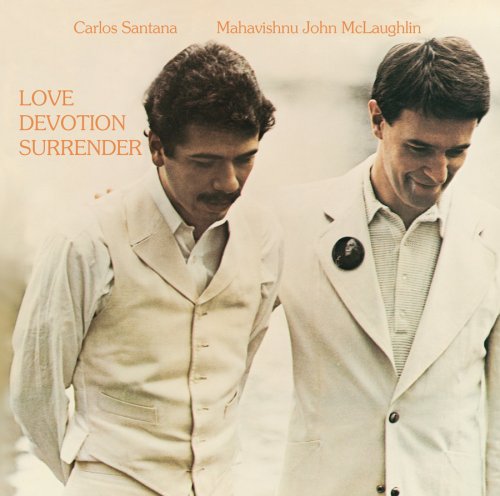
For guitar junkies, it was a feast.  It’s largely just two shred-meisters jamming, but MAN!  What jamming!  There’s, again, a lot of debate about this album.  Fans of each guitarist tend to claim their man as “the winner,” as if it were some kind of high-end head-cutting contest.  And, in some ways, that’s exactly what it was.  Rock vs. jazz, America vs. England, white vs. Hispanic, trained vs. untrained.  Carlos famously does not know how to read music, McLaughlin came from stints with jazz heavies like Miles Davis.

It was surprisingly democratic, however.  Both bands contributed, and both soloists got plenty of showcase time.  No one style, group, or soloist particularly dominated the sessions.  Which is exactly what I think they were striving for; a spiritual coming together of two massive talents, the likes of which is rarely seen.

It is interesting forty years on to go back and give it a listen.  Despite their unity at that time under Chinmoy’s big umbrella, their individual styles come shining through.  In a way, it was McLaughlin’s chance to school the street-educated rocker how to play “proper” music.  But while Mahavishnu’s playing is precise and expertly constructed, Carlos just burns with joy.  The jazz man is making all the changes and pushing the rhythm section while the rocker belches flame all over it.  And it’s a clear, shining flame that leaves no smoke and consumes all.  You could argue that Mahavishnu played better, but Devadip clearly had more fun.

And so begins the “post-Rolie” period, which pretty much continues through hills and valleys and around corners in various directions to this day.  The band’s next album, Welcome, continued the new Chinmoy theme with an all-white cover.  Signifying spiritual purity, y’know.  It was so pure, it was downright somnambulistic.  Actually, the music is damned good and pretty hot in places, but there are absolutely no burrs or dirt on it whatsoever.  Tom Coster, the new keyboardist, proves to be twice as good and half as interesting as his predecessor.  And at the end of the sessions, drummer Mike Shrieve, who made a name for himself at Woodstock with one of the greatest drum solos ever, left the band.

By now the roster was on revolving door mode anyway.  Upwards of thirty or more musicians and singers have claimed membership in the band over the years.  And every one of them has been top grade.

Essential albums:

The first three, for sure.  These are what the legend is built upon.  Welcome is good, Borboletta is better and rocks more.  Amigos is quite good, getting into more of a funk mode.  Yeah, it’s a little too cheery and light in places, but it cooks.  One of Carlos’ solo albums, 1979’s Oneness – Silver Dreams, Golden Realities, has some interesting stuff on it.

From the later ‘70’s, Moonflower from 1977 is a must-have.  It’s a double album with studio and live tracks mixed together.  Inner Secrets (1978) and Marathon (1979) are also worth a listen.  There’s a live album from 1975 called Lotus that is well worth tracking down.  Originally released only in Japan as a three-record set, I found it at a store specializing in imports.  It’s great, and a nice broad snapshot of the band in the Welcome era.  And it’s available now on 2 CD’s.

The ‘80’s started off well with ‘81’s Zebop, but after that things kind of tapered off.  They started using more synths and even synth drums in the studio, and the writing could, frankly, have been better.  The band started getting its groove back with 1990’s Spirits Dancing In The Flesh.  There was a long hiatus from the studio, but the live Sacred Fire is quite good.

And then came Supernatural.  Their biggest selling album, and surely one of the top 25 of all time.  It was a huge collaboration with a half dozen famous young guest stars, including Rob Thomas, Dave Matthews, Lauren Hill, and some old guy named Eric Clapton.  It sold over 15 million copies in the US alone and took every Grammy you could name.

And the album?  Well, it’s . . . pretty good . . . I guess . . .  Actually, the first song, Da le Yaleo, smokes!  Old school Santana at its best.  From there, it kind of slides downhill rather quickly.  Such is the nature of collaboration, I’m afraid.  Rob Thomas’ “Smooth” is the high point, and there’s some other tunes that work pretty well, some that don’t . . . on the whole it’s rather spotty.  But the good stuff was great, and the lesser stuff didn’t exactly suck.  I bought it, and I still play it.

The idea behind it, and the two albums that followed (Shaman and All That I Am) was to show how great Carlos is when he’s working with interesting people on interesting songs.  But the best example of this, the album that I think showcases his gift, the 2010 collection, Guitar Heaven.  Carlos and the band, with a smattering of guest singers, cooking as only they can cook on some rock classics.

Their version of Def Leppard’s “Photograph” is worth the price of admission, along with the AC-DC cover, “Back in Black.”  It was also an inspired choice to let Joe Cocker sing “Little Wing,” and this version of “While My Guitar Gently Weeps” is, maybe, even better than Jeff Healey’s.  Truly inspired, front to back.  Every bar band should own a copy.

And if we’re going to talk about essential Santana albums, we should mention the one that Carlos is NOT on!  Remember, I said we’d get back to Greg Rolie?  Well, in 1997 he got together most of the original Santana band, including drummer Mike Shrieve, guitarist Neal Schon and most of the percussionists, and did an album called Abraxas Pool.  Like secretarial pool, but with people that were on Abraxas, get it?

For those who think Santana was never as good as on the first three albums, this one will justify their position.  It absolutely smokes, and with Schon on guitar you hardly miss Carlos.  It’s the album that Caravanserai never got to be.  Trouble is, it came out just before Supernatural, and promptly disappeared without a trace.  That’s a shame, because it’s twice as good.  Anyone into Santana should have it.

So Who Is This Guy, Anyway?

That’s a good question!  Carlos Santana is one of the few front men in rock history that was NOT a singer.  Hendrix, Clapton, Stevie Ray, they all sang.  Carlos holds court from behind his Paul Reed Smith guitar, while the singers, from Greg Rolie through Leon Patillo, Greg Brown, Alex J. Ligertwood and others, come and go.

There’s a lingering impression that Carlos has always been a sideman in his own band.  Greg Rolie sang and wrote much of the material on the first set of albums.  Tom Coster came on board just as the band’s direction was changing, so it was assumed that he was leading the charge.  On the cover of Love, Devotion, Surrender, we see that McLaughlin has an arm around Carlos, as if he were the guide and teacher.  And then there’s the whole life-changing relationship with Sri Chinmoy.  It would be easy to think that Carlos was being led around by the nose.

But wait just a conga-thumping minute, there, bucko.  What’s the name of the band?  Not Rolie, or Coster, or Devadip.  It’s SANTANA!  In the beginning it was the Santana Blues Band.  There’s a good reason for that.  You scratch a little below the surface and it’s pretty easy to see who the he-bull is in that pasture.  Carlos and Rolie started disagreeing over the band’s direction, and it was Rolie who left.  Eventually he had a falling-out with Chinmoy, as McLaughlin had years earlier, and the band never did change its name to Devadip anyway.

As a band leader, Carlos most resembles Miles Davis.  The famous jazz trumpet player and composer surrounded himself with talented people, and then took advantage of all that talent to make HIS band better.  Whether it was John Coltrane or Wayne Shorter, Bill Evans or Herbie Hancock or John McLaughlin or Marcus Miller, no matter how well they wrote or played, no matter how much each in turn dominated the sound and direction of the music, there was never any question who was the boss.

It was Carlos who decided to mix rock with latin, move on to jazz, then funk, then experiment with electronica and then break out his rolodex and invite the younger generation to his party.  And it was HIS party.  Everybody’s interviews after the Supernatural sessions was about how honored they all were to be let into his world, to see what The Master would do with the raw materials they brought to his forge.  It’s Carlos’ world, everybody else just dances their funky booties off.

And frankly, I can think of worse places to be.

The way to catch Carlos is live.  It’s where the whole reputation was built.  I understand it was Bill Graham, their long-time manager and former owner of the Fillmore and Fillmore East, who convinced them to not randomly jam so much.  He felt that they should concentrate on songs.  You can hear the difference on the ’68 Fillmore album, mentioned above.  It comes from the days when they were more interested in showing off their chops than making cohesive music.  Good call, Bill.

I’ve had the privilege of seeing them in concert twice.  The first time was 1978 at the old Boston Garden, for the Inner Secrets tour.  Great show.  Just after the heavy Devadip period, but he was still hanging with Chinmoy.  He did a thing that night that apparently he didn’t normally do.  Whenever he was getting ready to really rip off a solo, he would quickly lick the fingertips of his left hand.  I know several people who’ve seen him live, and also quite a bit of footage of him, and nobody’s ever seen him do that.  Cool move, though.

The second time was at the 1982 or 1983 California State Fair, in Sacramento California.  Remember, the California State Fair lasts for about a month.  They have a big concert every night of the fair, plus lesser acts during the afternoon.  That year, Bill Graham Productions was booking the shows, so it was logical that Carlos and the gang would be there.

What was NOT logical was the situation they’d find themselves in; as the OPENING act for The Police.  Now, this was just as the Synchronicity album was topping the charts, so it’s understandable that they’d be the headliner.  But with a month of shows, nobody could figure out why Carlos was opening.  After all, Sacto is practically his back yard, and Bill Graham was his manager.  It was anomalous enough that there was speculation in the newspapers as to why it was.

The impression of coercion was not dispelled by the show itself, either.  Santana came out and did their scheduled 45 minute set, and just about burned the place down.  And when they were done . . . they were done!  No encore, no goodbye, nothing.  The place went nuts!  Out came the Police, who actually put on quite a good show, but nobody cared.  By the second song half the crowd had left, and most of the rest were screaming “Carlos!!”

Sting indeed!

So Carlos hit 65 last year.  If he comes to your town, go see him.  You’ll kick yourself if you don’t, especially if you like his music well enough to read this far.  Don’t miss the opportunity.  And if they finish with Toussaint L’Overture, don’t bother getting out your lighter.  He’ll burn brightly enough without it.

Monday, October 15, 2012

The Choice

They say there are three kinds of people; those who can count, and those who can’t.

Before I go any further, I’d like to tell you a story. This came to me several years ago from a gentleman who owned a bike shop. He said when he started the biggest maker of 10-speed (or, I suppose, multi-speed) bicycles was the French company, Peugeot. After a few years people started asking if certain features could be made available on multi-speed bikes; things like higher handlebars, a bigger seat, and knobby off-road tires.

He took these requests to his Peugeot representative, and the rep told him flatly; “That is not the proper way to make a bicycle.” And so the shop owner asked the rep from a small Japanese company, Shimano, that made bicycle derailleurs. His reply was; “How many do you want?”

Now, Shimano is the biggest manufacturer of bicycle derailleurs, and Peugeot is a small niche company, at least in this country.

Isn’t that interesting?

The thing I think is most disturbing about politics is how heavily invested people get in their chosen candidate and party. And most people I know who are political junkies, or even relatively politically aware, claim to be open minded and are willing to consider every candidate.

But the truth is, in 95% of the cases you can tell well ahead of time at least what party they are going to vote for in the Presidential election. Even if there’s evidence to suggest that their personal ideals and goals would be better served by the other side. I know this from personal experience. Early in 1984 I was wrestling with whether to back Gary Hart or Walter Mondale in the Democratic primaries. People who know me and my views might be surprised to learn that.

I know Democrats who cannot bring themselves to believe that the economy actually improved during the Reagan administration, or that it was Republicans that put the Civil Rights Act of 1964 over the top. I also know Republicans that insist that financial markets should be completely deregulated, in spite of the evidence that this is exactly what led to the great depression, and all the little depressions that preceded it.

Why it bugs me is that it keeps people from reading this. I am not trying to stir up the troops on “my side,” and I’m not trying to proselytize from the other side. I am trying to find out if my reasoning is any good. And I am actively trying to get intelligent people whom I respect, and there are many, to read this AND give me some feedback. This is how I’ve learned and grown over the years, and I’m not done yet.

So anyway, that was the big buildup to what I’m thinking about now. But before I get to that, a little history.

The political system we live under now has its roots in the post-Roman European model. The de facto leaders in most communities were the families that owned the most land. And most families, of course, tried to have a lot of kids. This was because kids provided help around the place, and also gave the parents somebody that could take care of them in their old age.

And so it became the tradition in the more well-to-do families to give one son over to public service, and another for the priesthood. This helped to lock in the authority this family enjoyed for the next generation.  It was also their way of "giving back."  This was called the Cavalier Aristocracy.  It's where leaders like George Washington, Thomas Jefferson, and James Madison came from. You could also argue that John F. Kennedy comes from this tradition.  All these men gave up wealth to serve.

I think it’s safe to say that it’s not only Western civilization that looks to its more elite members for leadership. It’s logical, really. You want to be a winner, you hang with winners. Back in the day, it was the landlords and the church that led. The landlords, because everybody worked for them. You might think the church, because of devotion to God. But as much – or more – than that was the fact that the church used to be the only place one could get an education.

So it is the wealthy and the educated that lead. And things go smoothest when they're on the same page. Eventually, the landlords became Lords, royalty, and formal governments were formed. These, over time, went more toward the Roman model, and now the standard is a representative form of government. But it’s still the elite that populate the halls of government.

And as for the church, their influence has waned, but the influence of the educated class has not. That is because education has become more widespread. And yet there is still an elite among the educated, and these are the people who get called on by government to help lead. Woodrow Wilson, who was President of both Princeton and the United States, is a prime example. Condoleeza Rice came out of academia to serve in several administrations, and there are many others.

That is the choice we are looking at in this election; the landlords and the scholars. Mitt Romney represents the Capitalists, and Barack Obama, the Professors. There are endless ways to frame this. The Pragmatists and the Theorists. The Fat Cats and the Eggheads.

Mitt Romney’s core was probably best expressed by Charles Erwin Wilson, who said; “What’s good for General Motors is good for the country.” Or, as Calvin Coolidge once said, “The business of America is business.” The United States has a free-market capitalist economy. If business is allowed to do business, the wealth it generates trickles down to everybody. Refer, please, to the collected writings of Barry Goldwater, Jack Kemp, and Ronald Reagan.

Barack Obama and those who inspired him believe this system is inherently unfair. They believe that business needs to be strictly regulated and that wealth needs to be more evenly distributed. They believe that business should be exposed and called out every time they make a product that is unsafe, or pollutes, or is made by people who are paid very little and treated very badly. Ralph Nader would fall into this category.  They also believe, deep down inside, that the world would be a better place if there were one government presiding over the whole world.

Karl Marx in “The Communist Manifesto” states that history will inevitably lead to a society where everyone works together for the common good. Communism might be better called “Communalism.” As Archie Bunker once said, “If you live on a commune, you are a commune-ist.”  There is a lot of truth to that, and if you read Marx it looks great on paper.

For a picture of what pure socialism looks like, watch Star Trek. This franchise shows us a world where there is no money and everybody does what they feel they’re best at. Writers write, musicians play music, science geeks become scientists, people who love food become chefs. It’s to be assumed that the plumbers all love working with pipes and water, and that ditch diggers love to dig. The point is, nobody has to have a job they don’t like, and everybody has enough, because whatever you need, somebody else loves to make and provide it.

Of course, advanced technology will eliminate a lot of the less desirable jobs. Ditches would be dug with phasers from orbit, I suppose. Modern technology has already come a long way toward eliminating things like books, magazines, and newspapers, so nobody would ever have to work in a dirty, noisy, dangerous printing plant. The things writers write would go straight to digital. Kind of like this, now that I think of it.

One of the biggest differences between the capitalists/fat cats and the scholars/eggheads is a theory known as the zero-sum game. Basically, this is the belief that there is a certain amount of value to everything in the world, and that sum never wavers. On the surface that sounds ridiculous, but please, dig a little deeper with me.

Let’s say, for instance, that you have a pile of dirt. Not very valuable, from the looks of it. Ah, but you discover that a lot of that dirt is iron ore. You separate the ore, smelt it, refine it, and voila, you have steel. Now it’s become more valuable. Then you take the steel and make something out of it, and it’s more valuable yet again.

And yet under the zero-sum model, you haven’t increased the value of the whole, just one small part. That pile of dirt is but a small part of all the world’s resources. When you increase its value, you decrease the value of everything else proportionately. If the whole world is worth $100, the pile of dirt starts out being worth $0.01. Make steel, the dirt’s value increases to $1.00, so the rest of the world is now worth less; $99.00 as opposed to $99.99. Make a bridge, the dirt – including the steel in the bridge – is now worth $3.00, making the rest of the world worth only $97.00. Follow?

So by this model, all the technological advances in history, all the knowledge gained by the study and manipulation of the natural world, all the exploration ever done, has only redistributed the wealth of the world, not increased it. We have also increased the number of dollars in the world, making each of them worth less. So the original $100 is now $1 billion, but that billion is only worth what the hundred used to be. We’re simply calling the original value something else now and dividing it into smaller pieces.

To follow this logic, in order for the world to be fair, that wealth has to be taken back from the people who have benefitted from all that study and work and creativity and given back to the rest of us for whom living on a pile of dirt is our fate.

The landlords/fat cats/capitalists tend more to believe that the potential for wealth is infinite. I will agree that there are rich people who seek to gain wealth by exploiting the poor, but we’ve learned that insisting on things like a 40-hour work week, child labor laws, environmental and safety standards, and a minimum wage have not diminished the potential for wealth. If anything, it’s expanded it, because now the capitalist industrialists have more customers, who live longer and are happier.

So this piece is not meant to sway you into voting one way or another. It’s merely designed to be an examination of the deeper motivation of each side. Hopefully, it will help you understand the people that you look at and shake your head over, thinking; “How the hell can they be like that?”

The choice we’re being offered seems quite clear to me. Do we follow the scholars, or the businessmen? Or, might there be a third choice? Might it be possible to make both of them follow us? Maybe there are more than two choices after all. I think this is what the Tea party and the Occupy Wall Street movements are all about. If you think that we, the people can have more influence over our nation, then maybe you should think about which side is more likely to give us what we really want, which is a strong economy AND a more responsible society. More cars, less pollution.  More customers, less exploitation.

Which brings us back to my story about the bicycles. One rep felt he knew more about how to build a proper bike than the people who weren’t buying them. The other wanted to do business. The first fellow probably thought that, if they just took what Peugeot made, one day everybody would see the wisdom of it and thank them. The other rode the wave of mountain bikes and got rich.

I would like to recommend a very enlightening book to all my friends. It’s called “Twenty Dollars A Gallon,” by Christopher Steiner. No matter who you agree with, you owe it to yourself to read this book.

Saturday, September 22, 2012

Peeing in Rush Limbaugh's Pool

I can still remember the first Earth Day.  April 22, 1970.  I was in, lessee, 9th grade maybe?  It was a big deal.  For the previous couple of years the public's consciousness had been getting raised about ecology.  It probably started with Rachael Carson's 1962 book "Silent Spring."  A great, and chilling, read, even today.  I went to Mascoma Valley Regional High, and we had just started a 4H chapter in Dorchester.  In celebration of Earth Day, we went out and picked up trash along the roads.  Got quite a lot, too, and felt really good about it.  To this day I never throw trash out the window of my car, but keep it in a bag and throw it in a proper receptacle.  Thanks, by the way, to Wal-Mart, Dunkin Donuts and all the other places that provide trash bins for travelers to clean out their cars into, disposing of it in a more responsible manner.

In light of that, you might wonder what I think about the ongoing debate concerning global warming.  Don't bother.  I don't have an opinion.  Not being a scientist, I have no idea whether or not global warming is actually happening, or if it's the fault of mankind.  And really, that's not the issue, is it?  What they're really trying to do with this scary story about melting ice caps and such is say something very simple; pollution is bad.

And it is!  This isn't rocket science.  And it doesn't matter if it's causing the climate to change or not, it's bad anyway.  Trash, and smog, and toxic waste in the water are all bad and we should, indivually and as a society, strive to live cleaner and greener.  We should make cars that pollute less for the same reason we should wash our hands before eating.  And if you don't know why that is, I'm sorry, but you were raised wrong.

But it's become a political issue.  One side has latched onto some sketchy and controversial science to make their point by declaring that mild winters are GM and Exxon's fault.  This gives the other side free reign to question the whole idea.  It leads to things like Rush Limbaugh encouraging people to buy a Humvee and fill it with high-test and drive until you can't stand it any more.  They scoff at the very idea that the activities of man could possibly cause this much harm to the environment.

So . . . how would these people feel if you went up to the edge of their swimming pool, drew down your zipper, and relieved yourself?  Why, they'd be horrified!  The water would quickly change from blue to green, and they would be sickened by the idea of jumping in.

So why has this got to be a big Liberal-vs.-Conservative issue?  Isn't cleanliness next to Godliness?  Didn't your mommy teach you to wash your hands before dinner?  And I'm not just jumping on the Conservatives for this, because the Liberals think we're so stupid we need scary stories to motivate us.

What I'm proposing is simply this; intelligent government.  Unfortunately, this will require an intelligent electorate.  One more interested in facts than slogans and helping "their side" win.  Care to join?

Sunday, April 29, 2012

Songwriting: Pearls vs. Diamonds


Have you ever held a pearl and really, really looked at it?  It's easy to see why they're so expensive.  They're beautiful, and they're also fairly difficult to collect.  Hold one up to the light; it's transluscent.  It looks like you can see deep inside it.  You know how they're made, of course.  Yeah, an oyster gets a piece of sand stuck, squirts some kind of juice all over it.  They cultivate pearls, too.  I guess that means they stick pieces of sand inside oysters.  Sounds . . . irritating.

Over the last couple of years I have gotten back to writing songs.  I've been inspired to do so by a couple friends of mine who are excellent songwriters; namely, Sky King and Jim Tyrrell.  Because of their inspiration I have gotten back to basics and been writing what could best be described as folksong-type songs.  A couple of verses, a chorus, maybe a bridge, not worrying as much about arrangement or style as expressing an idea.  Keeping it simple.

I consider songs like this to be like pearls.  One thing.  Simple, and beautiful, and often born out of things as small as a grain of sand, or any sort of emotional or intellectual irritant.  Something that deserves to be sung about.  Musically, it starts at the beginning, goes until the end, runs over whatever bumps are in the middle.  Hard to beat simple.

Now, if you follow this mess of bloggery and read the last couple of pieces, you know that I'm deep in the throes of a Kansas binge.  Got every album of theirs that I could lay my hands on and listened to them all, then went back to the beginning and started over.  As a break from that, I've veered away and dug out my collection of Steve Hillage, a very interesting Brit whose heyday (hayday? heydey?) was the late '70's.  Lots of similarities, once you break it down into the writing scheme.

Kansas, and Kerry Livgren in particular, had a distinctive style.  His songs tend to be made up of lots of little pieces stuck together.  One leads into another, and then another, which gives these songs a cohesiveness.  It's not just velcroing random parts together.  More like building a Ferrari.  You could actually take an early Kansas tune, break it down into its various chunks, and then flesh each of those chunks out into a whole album's worth of simple pearl-like tunes.  There are actually pros who do that sort of thing; grab a jazz album or a classical piece, pull out a riff or scale, and use it as the basis for a country or pop tune.  Randy Bachman of BTO actually admitted to doing so in a Guitar Player interview back in the '70's.

Have you ever seen a raw diamond?  It looks like just a rock, albiet kind of a transluscent one.  A jeweler takes a raw diamond and shaves it at various angles until the surface is covered with flat planes, or facets.  This allows light to travel through it and be twisted into various angles, giving it the visual beauty for which they are so famous.  Kansas songs, most of them, are like diamonds.

There was a point at which my songwriting had gone diamond-style.  They usually started with me experimenting with various sounds on the guitar or keyboard.  Then a lick, a chunk of a scale or something, would connect with that sound, and the process would begin.  At this point, it's decision time.  Do you just let it go around back to the beginning?  Do that a couple of times and you've got verses.  If that's not enough you come up with a chorus, maybe even a bridge.

Or, do you throw standard song-form out the window?  The verse you started with comes to a terminus.  Instead of another verse, you can take it on a sharp left turn.  Maybe you don't even let it become a whole verse.  See if you can find another lick to compliment the first one, and follow that thread a ways.  Especially good if it brings out a different lyrical thing, kind of like turning the stone and letting the light strike the facets from a different angle.  It becomes like building a Song out of little song-lets.

I'm currently working on a tune that's kind of an homage to the Marines in my life.  For whatever reason, the good Lord has seen fit to surround me with Marines.  My father-in-law, my pastor, the previous pastor, the drummer for the Red Hat band, his biker buddies that come to our shows, and they're all awesome people.  A poor ol' squid like me ain't got a chance.

The song was inspired by something my pastor, David Moore, said in a sermon recently.  As an illustration he was describing a situation he faced back in Vietnam.  He and his men came back off one mission but were immediately ordered out on another with some newbies.  They were tired, but it needed to be done, so they went.  And in doing so, they showed the green ones how to get the job done.  The way he put it was; "We were hard."

It wasn't said in a prideful way, like they had their chests puffed out and were going to show these greenies who da man.  It was just a statement of fact, like a weather forcast.  They were hardened, tempered, ready.  Wimping out and crying foul was not an option.  You get back up, grab your pack and your piece, and get it done.

The way the song fell together was almost automatic.  For once, the words came first.  Usually, I find the musical germ and let that settle the pattern the words will have to fit, but this was different.  In two short sittings the lyrics were right there, BAM!  Like writing a news story.  Three verses, seeing a moment through the eyes of a Marine, first in Vietnam, then Iraq, and finally at Valley Forge.  Each verse ending with the words, "We were hard."

So now I have to build some music around that.  I took an afternoon and went out to my office, plugged in my amp and effects unit, and grabbed my beloved Godin LG-90.  Tuned it to an open D, because I've been trying to do more with open tunings and slide, two things I dearly love and am not very good at.  Played around with some different effects and tonal colors, and found a lick.  Knew immediately that this lick was for those words, and got 'em out.

The first verse is a hard 2/2 beat, front pickup, compressor on, and a little of the amp's tremolo to make the light dance through it.  Just the guitar at first, with maybe the kick drum hitting the 2's for the first half, then the drums and bass coming in but beating hard on that 2.  Second verse kicks the heat up a notch, giving that bluesiness a bit of country twang but with more punch than boogie.  Third verse would take it back to the beginning, but finishing up more like the second.

So I got that far, but it needs more.  Left at that, it's about 2, 2 1/2 minutes long and frankly wouldn't leave much of an impression.  There needs to be a bridge between 2 and 3.  Instrumental, because more words aren't necessary.  Something that expresses the feelings; of coming in off the hard march, tired and hungry, and there's trouble, so you go back out.  Something a little angular, a little painful, maybe a quick shout to get the blood pumping, a roar at the sun, and go.

By this point, it was supper time, but as I'm packing up to go back in the house I heard a faint lick on the edge of my mind to think about until next time.  And it's seven notes long, so there's another decision; do I add the eighth-note rest, or build around the seven pattern?  The lick feels solid, so there's the angle and the twinge of pain.  I guess I'm going to let the Marines march through Kansas.

Now, this is a band song, so don't ask for it at the Green House.  And Red Hat don't do originals, so I'll have to call Tod again, or maybe Rocco, and push some more on the side project.  Stay tuned, and toss up a little prayer for me if you don't mind, and I'll keep you posted.  I'm dying to hear how this comes out.

Wednesday, April 25, 2012

People of the South Wind


The subtle and relentless advances in audio technology that have taken place during my lifetime are truly marvelous to behold. Or, be-hear, maybe. When I was growing up and beginning to collect music, we had advanced up from the 78 rpm record that held about 3 minutes of music to LP (Long Playing) records that held maybe as much as 20 or more minutes per side. Now, of course, everybody’s walking around with tiny MP3 players that hold more than my old record collection.

Somewhere in between those extremes we find the MP3 CD; a CD that, instead of holding simple audio files contains instead MP3 or WAV versions as data files. In this way, one can put sometimes 8, 10, or more “albums” on a single disc. I have recently acquired a car stereo that plays these MP3 CDs, and it has been a revelation. I can put an entire artists’ catalogue on two or three discs, put one in, and that’s what I’m going to listen to for the next week. Diggin’ it.

My latest excursion has been through the collected works of a group known as Kansas. Supposedly, the Indian word “Kaw,” from which the word “Kansas” is derived, means “People of the South wind.” Cool, eh? In reality, it should mean “people for whom the earth revolves around Kerry Livgren.” There have been many excellent musicians and songwriters in this band, but Kerry Livgren has always been the main dude. Even when he’s not in the band.

Like any long-term creative entity, Kansas has been through various periods of development. The Kansas band that got signed to a record deal and started making albums was actually the third incarnation of the band, which will come up again later. Their first three albums, “Kansas,” “Song for America,” and “Masque,” make a sort of set in which experiments were conducted and the band’s sound was solidified.

If there’s a problem with virtuoso musicians when they’re young, it’s that they feel it necessary to play at inhumanly fast speeds. For the uninitiated, listening to these first three albums can be a trifle exhausting. Well worth the effort, though. Excellent writing and arranging, spot-on performances, and for all the notes flying around, not one is wasted.

Many groups in the progressive rock arena took sometimes several albums, and several years, before really getting a handle on things. Not so with Kansas. From the first song on side 1 they hit the ground running and never looked back. If there were an award for best first prog-rock album, the first Kansas album would win hands down. Really, the only thing that took them a while was finding an audience. As good as these albums were, only a small cult following knew it.

Their first release was issued in 1974. By ’76 they had three relative flops in a row and were on the verge of being dropped by their label. When they went into the studio to begin work on their fourth album, Steve Walsh – the lead singer and other primary songwriter – announced that he had writer’s block and had brought no new material with him.

This turned out to be not such a bad thing. Kerry Livgren wrote or co-wrote every song on the record, and “Leftoverture” became and remains their best selling album to date. It starts with a song that he didn’t even mention to the band until the last day of recording, when it was decided they needed one more song. They ran through it once, laid down the track, and it became one of the biggest selling songs of the ‘70’s; “Carry On, Wayward Son.” It’s still a staple of classic rock radio. By this time their playing and writing had matured. It is, arguably, their best album overall. It also kicked off the next epoch in the Kansas story; The Popular Years.

The sad thing about peaks is that they lead directly to going down the other side. Many people pair that album together with the next one, “Point of Know Return.” I can see that, because they were both very confident, upbeat records. They were also very popular, and “Know Return” contained their other two most famous singles, the title track and “Dust In the Wind.”

But I pair “Know” with the one that followed it, “Monolith.” By this time there was a distinct Kansas Sound, and consequently a Kansas Formula. It seems you could write a Kansas song almost like you’d fill out a form, making sure all the required elements were in place. Some of the songs on these two albums sound like that. Now don’t get me wrong, there’s still some great stuff here, but for the first time there are songs that, frankly, they could have done without. If you took the best tunes from both, you’d have one great album.

“Know” and “Monolith” are like opposite sides of the same coin. “Know” is more upbeat, “Monolith” darker and more serious. Most annoying are things like the second cut on “Monolith,” titled “People of the South Wind.” We’ve already discussed where this title came from. The chorus says:

We’re the people of the south wind
The people of the southern wind

Now think about that for a moment. Are they the people of the SOUTH wind, or the SOUTHERN wind? If those two things are the same, why not pick one? If this is something by which you want to identify yourself, why leave it that vague? Why not put a little more thought into the second line, instead of just sticking something in there that fit the number of syllables?

Even so, the level of performance remained at the highest level. Up to this point I cannot recall a time when anyone in Kansas was just phoning it in. Even with Livgren and Walsh’s writing beginning to show signs of weakness and fatigue, Walsh always sang with passion and played the keyboards brilliantly.


The whole band was great. If Kerry Livgren was the brain, and Steve Walsh the voice, then violinist/vocalist Robby Steinhardt was the soul of the band. He’s a classically trained violinist, and in a band with three strong soloists and a great singer he staked himself out a place of his own. He also acted as the Master of Ceremonies for the band when playing live. If you want a clue on how incredible this band was, listen to any of their early stuff and pay close attention to Robby’s violin parts. Then realize that, unless Steinhardt shared a writing credit, his part was written out by Livgren. He was also a very good singer, his slightly rough, strident voice making an interesting counterpoint to Walsh’s soaring high tenor.

The rest of the band was this good as well. Drummer Phil Ehart, along with guitarist Rich Williams, are the only members to appear on every Kansas album. One of my ongoing complaints with their earlier recordings is that the drums never quite sound right. Ehart was extremely talented, and yet the drums always sound thin and somewhat muffled on the record. Bassist Dave Hope kind of disappeared into the background, but remembering that a lot of the parts were written out he gets credit for being able to play them.

Second guitarist Rich Williams is an interesting case study. Livgren, of course, set the tone for everyone else as not only main songwriter, but on keyboards and lead guitar as well. Even so, Williams wasn’t relegated to a simple rhythm guitarist role. His solos are hot, smokin’, and easily recognizable next to Livgren’s.

Williams seems to be the perfect sideman, rolling with every change and carrying his part with grace and class. In the band’s latter days he is the only guitar player, and holds up his end AND Livgren’s on the older material. He’s got a good gig and he knows it. That’s called mental health, people. On the whole, in spite of Livgren clearly being the Alpha Dog on the block, it’s a very democratic band with everyone having ample opportunity to shine.

Now, at this point I want to state that I am deliberately ignoring a major development in Kerry Livgren’s personal life. The reason is that, once it’s out there, it colors everyone’s perception of him and all the music he did from this point on. The purpose of this piece is to discuss the MUSIC of Kerry Livgren and Kansas, not his personal life.

In late ’79, early ’80, Livgren began recording his first solo album, “Seeds of Change.” In my humble opinion, it’s brilliant. It’s still one of my all-time favorite albums. Great songs, and guest performances by a wide range of musicians from fellow members of Kansas to vocalists Mylon LeFevre and Ronny James Dio. Worth of mention here is the song “Living For the King,” vocal by Dio and featuring one of my favorite guitar solos ever. There is something about this album that elevates it head and shoulders above “Know Return” and “Monolith.”


This vibe carried over to the next Kansas album, “Audio-Visions.” Despite touching all the bases of the “Kansas Sound” there’s nothing on this album that resembles the lowest fill-in-the-blank points of its two predecessors. Of particular note are the third and fourth songs, which work brilliantly together. Cut #3, “Hold On,” is a beautiful ballad by Livgren that manages to avoid the worst “power ballad” excesses and features a passionate vocal by Walsh. That leads right into the Walsh-penned rocker, “Loner,” kicking it off by repeating the last line from “Hold On,” a note higher. It sends chills down your spine. While not quite as good as “Leftoverture,” it’s still very, very good.

Unfortunately, it also marks the end of the band’s second period. “Audio-Visions” was the last Kansas album to earn a gold record. Philosophical differences between Livgren and Walsh caused the latter to leave and start his own band, “Streets.” This left open a seat for a lead vocalist and keyboard player.

For some inexplicable reason, the person chosen for the job was John Elefante. I’ve seen a short list of people who were passed over in Elefante’s favor. Having heard most of them, the question arises; what the hell were they thinking? He isn’t half the singer that Steve Walsh was. There must have been something about him that fascinated Livgren. It was a little like watching John fall for Yoko.

The Elefante period is marked by two albums with musical puns for titles; “Vinyl Confessions” and “Drastic Measures.” That also describes the music contained within, at least by Kansas’ high standards. “Confessions” is particularly dire, and you’re deep into side 2 (for you who remember vinyl) before hearing anything really resembling Kansas. “Measures” at least rocks harder, but it’s still not very good.

Violinist Robby Steinhardt is barely noticeable on “Confessions,” and the Wikipedia article on the band says that he “didn’t show up for the sessions for the next album.” After the support tour for “Measures,” Livgren himself left the band. He gathered some musicians, among them Warren Ham and Mike Gleason, both of whom Elefante had beaten out for the lead vocal chair in Kansas, and went into the studio to record his next solo album.

The session gelled so well that they decided to form a new band. Unfortunately, Livgren was contractually bound to Kansas for life. Livgren’s autobiography, also titled “Seeds of Change,” says that there was a small loophole, although again the Wikipedia article says the loophole was negotiated with the record company, that allowed him to form a band as long as they were marketed to a particular demographic. And so was born the band, “AD.”

I have the first two of AD’s four albums, “Time Line” from 1984 and ‘85’s “Art of the State,” and they’re excellent! Musically they hearken back to the “Audio-Visions” days, but moved on a little further. What is most striking, and different from Kansas, is an air of downright playfulness. As intricate and sophisticated as the music is, they sound like they’re having a great time playing it. And even writing it! Seriously, I could never imagine Kansas pulling out a song like “We Are the Men” from “Art of the State.”

The rest of Kansas didn’t entirely fade away, though. In 1985 Walsh, Williams and Ehart grabbed a new bass player and uber-fusion guitarist Steve Morse for a new album. It’s tempting to refer to this as the Morse years, as he got a lot of writing credits and was, after all, Livgren’s direct replacement. But it would be more honest to call it the Post-Livgren period.

The three albums this grouping recorded between ’85 and ’95 were . . . well, they were actually pretty good, and got progressively better. But they don’t really sound like Kansas. Frankly, they sound more like Journey or Styx. Which isn’t a bad thing . . . unless you’re really expecting Kansas. But Kansas without Kerry Livgren . . .

The first was “Power,” and Morse gets more writers’ credits than Walsh. Three years later was “In the Spirit Of Things,” which was a loosely-constructed concept album about the 1951 flood of Neosho Falls, Kansas. O-o-o-kay. And it took until 1995 for them to do another, during which time they were dropped by their label. Everything from “Freaks of Nature” on has been released on their own label.

They did reunite with Livgren for a tour between “Spirit” and “Freaks,” and even got David Ragsdale, another violinist, so they could do the older stuff live and sound more like themselves. But Livgren left after a while and Morse came back to do “Freaks” and finish their touring commitments.

In 1997 Ragsdale left and Robby Steinhardt returned! The band went into the studio with an orchestra and recorded “Always Never The Same.” It’s an odd collection; a couple covers, a few new tunes, and the rest old Kansas stuff. It may have been a mistake to do this one, because it just emphasizes how great Kerry Livgren’s songs from the ‘70’s were. But it sounds really great, and it shows just how good Rich Williams is on lead guitar. With no Morse or Livgren to cast a shadow over him, he steps forward and rocks the house.


In 2000 Kansas did it’s most recent album, “Somewhere to Elsewhere.” There is some mystery shrouding this album, because all the songs are by Kerry Livgren, even though he’s not officially back in the band. There are stories around that AD was more of a creative success than a financial one, and that he was left with quite a lot of debt. This is given as an explanation in some circles regarding the release of the last two AD albums, and for his offering these songs to Kansas. The other explanation is that they were desperate to touch base with their old fans, and went to him first.

Whatever the reason for doing it, the album . . . well, it’s not bad. Really. It’s probably better than any album under the Kansas name since Audio-Visions. But remember what I said about the first three albums, that everything was played at breakneck speed? That’s not a problem here. Everything seems so ss-l-l-o-o-ww in comparison. The songs aren’t bad, and if you like Kansas they’re probably better than anything from the Morse years. They’re just, well, kinda sleepy.

Livgren had what is described as a “massive stroke” in 2009, but since has recovered enough to continue to write, record, and tour. Remember what I said early on about the Famous Kansas being the third version? Well, the second version’s demo tapes got released in 2003 as “The Lost Kansas Tapes.” It attracted enough attention that Livgren got THAT Kansas back together for some more recording and a tour of Europe. It went well, so that’s been an on-again, off-again project working under the name of Proto-Kaw.

Livgren also has his own small label and production company called Numovox, and has done a few solo albums. I’ve only heard one, a collection of instrumentals called “One of Several Possible Musicks.” Didn’t care for it, frankly, but oh well. And that’s about it, I guess. I’m going to try and get my hands on some Proto-Kaw, and if I think it’s worth a mention I’ll do so.

Of course, it wouldn’t be worth doing one of these without making a recommendation for your collection. If you’re going to get one and only one Kansas album, make it “Leftoverture.” If you don’t like that one, you won’t like any of them. If, on the other hand, that whets your appetite for more, go for the three that came before it; “Kansas,” “Song for America,” and “Masque.”

Once you’ve gone that far, you owe it to yourself to get “Audio-Visions” and Livgren’s first solo project, “Seeds of Change.” By then, what the hell, go find some AD; “Time Line” and “Art of the State” are the best. If you must go further, head for “Point of Know Return” and “Monolith,” along with their first live album, “Two For the Show.” Only then should you consider getting the Morse albums and beyond, or just seeking counseling.

And finally, I would be remiss if I left you with the impression that Kerry Livgren was the whole band.  The Elefante years proved that they also needed Steve Walsh.  And Robby Steinhardt.  And as good as a lot of Livgren's work aside from Kansas has been, the six original members had a certain chemistry that could not be reproduced.

So enjoy the feel of that South wind on your face, and carry on, my wayward son.

Monday, April 23, 2012

Group Dynamics


A rock band is, inevitably, the interaction of two or more people.  How these people interact is always as unique as the people themselves.

The most popular group of all time were The Beatles.  The primaries in this group were, of course, John Lennon and Paul McCartney.  Originally John was the leader of the band, but over time Paul and his songs gained ascendency as John succumbed to internal pressures.  George grew resentful over the duo's control, and Ringo remained philosophical.  It was, of course, much more complicated than this, but that's pretty much it in a nutshell.  The struggle of egos finally broke them apart.

Every group of musicians, rock, country, jazz, even a symphony orchestra - heck, every group of people for any purpose - has its own group dynamic.  This dynamic directs what material gets done, what the next step in their development will be, and how long they'll last, among other things.

Duke Ellington was famous for writing concertos for his primary soloists.  During the Big Band era it wasn't unusual for a lead musician to leave, either to take a better offer from another band leader or to form a band of their own.  Ellington was able to keep his core group together for decades by showcasing them with pieces written specifacally for them.

The Doors didn't play anything except by unanimous consent.  They were known to halt a show for several minutes and argue about what to play next.  NRBQ, on the other hand, went on stage without any set list at all.  Their drummer, Joey Spampinato, called tunes on the fly.

Rush has survived with the same three members for about 35 years.  They have a unique ability to divide up responsibilities on every project; one will do the cover, one will oversee the promotion, another will do something else.  As a writing team, the drummer, Neil Peart, will submit lyrics.  Then the guitarist and bassist, Alex Lifeson and Geddy Lee, work out the music, tweaking the lyrics with Peart as necessary.  Lifeson is presented as the real leader of the band, but if he is he's a very wise one, leaving the others plenty of spotlight time and creative credit.

I especially like a comment he made in a recent video on the history of the band.  Peart wasn't the original drummer, coming in after the first album was already released.  There was the inevitable getting-to-know-each-other period while they were on the road, and Lifeson noted that Peart was always reading.  And some pretty heavy stuff, too.  His reaction was, "Gee, I bet this guy could come up with some awesome words."  And so, Peart was tapped to write lyrics.  A lot of band leaders would have seen someone like Peart as a threat, but Lifeson's attitude was to use that talent to improve the band.

A lot of bands center around one person who serves as the main provider of material and the front man in live situations.  Jethro Tull has Ian Anderson; Dire Straits, Mark Knopfler; John Fogerty served this function for Creedence Clearwater Revival.  Sometimes there are a duo who act as the band's primaries, like Mick Jagger and Keith Richard do for the Rolling Stones, or Robert Plant and Jimmy Page for Led Zeppelin.

Fleetwood Mac are a unique entity in the annals of rock.  Begun largely as a backing group for guitarist Peter Green, he was so impressed with his rhythm section of Mick Fleetwood and John McVie he suggested it as a name for the band.  When he left, the band continued on with other musicians through several iterations, keeping the name along with the rhythm section.  The new people each took a turn as tacit band leaders, but Fleetwood and McVie remained the constants.  Fleetwood even acted as the band's manager for a long time.

Another unique band was Rockpile.  This was a four-piece rock band that never played under that name until near the end of their time together.  The primaries in this group were guitarst Dave Edmunds and bassist Nick Lowe.  Both were songwriters and singers, and both had flourishing solo careers.  Whichever one had a new album to promote, the rest of the band would act as their backup for the following tour.  When it was time for everyone to go their separate ways, they recorded one final album as Rockpile and called it a day.

Supergroups are an interesting phenomenon that came out of the 1960's.  Cream are widely regarded as the first of these.  Eric Clapton rose to prominence playing guitar for the Yardbirds and John Mayall's Bluesbreakers.  He played with bassist Jack Bruce in the Bluesbreakers.  Bruce had previously played with drummer Ginger Baker in another group, and the three decided to join forces.  Although Clapton was arguably better known in the US, Bruce was clearly the leader of the band.  He handled most of the songwriting and lead vocal duties.

Probably the most successful of these bands was Crosby, Stills, Nash, and Young.  Each had been in another popular band before they joined forces.  David Crosby and Stephen Stills met and became friends when they were in the Byrds and Buffalo Springfield respectively.  Graham Nash, singer and songwriter for the Hollies, met Crosby when the Byrds came to England.  In 1968, after the Byrds had fired Crosby, they met up again in California.  Crosby suggested they get together with Stills, whose band had imploded the year before, for a jam session at "Mama" Cass Elliott's home.  The rest, as they say, is history.  After a successful first album, they needed more musicians to back them up on tour.  Neil Young, who had been with Stills in Springfield, was brought on board and given equal billing.

This worked well as a partnership.  Crosby was the creative flake, always experimenting with alternate guitar tunings and musical ideas, and had a real gift for harmony.  He wrote songs like "Almost Cut My Hair," "Carry On," and "Deja Vu."  Stills was the workhorse of the band, playing everything on the first album except drums.  Not as wildly creative as Crosby, he was probably the most solid musician and songwriter.  His songs include "Suite: Judy Blue Eyes" and "49 Bye-Bye's."

Graham Nash wrote the hit singles, and they were great ones.  He gets credit for "Marakesh Express" and "Teach Your Children," among others.  As a trio, they seemed unstoppable.  Their pop instincts were brilliant, and their various talents complimented each other.  Enter Neil Young.

In his own way, Young was the equal and the inverse of each of the other three.  He wrote big hits, played every instrument, and was fearlessly creative.  But he was volatile, unstable, and darker than they were.  It could be argued that the album, "Deja Vu" from 1970, was a quantum leap above its predecessor, "Crosby, Stills, and Nash."  But the only two studio albums the quartet did after that were in 1988 ("American Dream") and 2004 ("Looking Forward"), and neither of them are very highly regarded.  As a trio, however, the other three have survived and thrived.

One thing that really drove this band was the ongoing competition between Stills and Young.  Young has always been singled out as the creative genius and his solo career was much more successful than that of the other three.  Stills, on the other hand, was never happy as the "little brother," and was always pushing to exceed his friend, while at the same time celebrating him.  His solo albums have included several of Neil's compositions.

The inner dynamic of The Beatles was a lot like this.  Paul McCartney was ever in John Lennon's shadow, even after songs like "Yesterday" made him the most popular songwriter.  Paul was The Cute One, but it was John's band.  This dynamic continues to this day, with Paul ever striving for John's respect, even after the latter's death.  Think on the 2002 live album by Paul, "Back in the USA," where he credited all the Beatles-era songs to "McCartney/Lennon" instead of the usual "Lennon/McCartney."  Nah, no psychological issues there.

Sometimes a band does well because the principals find a way to work together well and compliment each other's strengths, while de-emphasizing each other's weaknesses.  One example; a casual listen to CSNY's "Four-Way Street" reveals that Nash, in a solo setting, was pretty weak at guitar and piano.  But they wouldn't have gotten nearly the radio airplay without his songs, and his high tenor voice made their famous harmonies work.

Other times it's simply a matter of the band accepting their role as sidemen for their resident genius.  A group like Jethro Tull changes personnel regularly, but remains largly the same.  Charlie Watts sits grinning behind the drumkit behind Jagger and Richards, happy to be in one of the biggest bands of all time, and doing as he darned well pleases in his off-time.  Since the early 1960's they've had three lead guitarists, but only one drummer.

And sometimes three, four, or more powerful egos manage to find a way to work together for the common good.  Credit gets spread around, creative urges are indulged, and the show goes on.  Rush is a great example of this.  So is U2.  Lynyrd Skynyrd would fit into this catagory, operating mainly as an extended family with no real leader, especially since the passing of original lead vocalist Ronnie Van Zandt.  In groups like this, decisions are made by concensus and everybody has room to explore their own muses.

Speaking of Skynyrd, it would have been interesting to see how their relationship with Steve Gaines would have gone.  Gaines was brought in to replace departing guitarist Ed King, who is coincidentally back with the band.  Gaines proved to be a powerful singer and singwriter, sharing a good portion of those duties on his one studio album with the band, "Street Survivors."  It would have been interesting to see if he'd broken away for a solo career, or if Van Zandt would have let him have more of the spotlight.  Unfortunately, he died in the same plane crash as Van Zandt, ending the first era of the band.

The point of this is not necessarily to express a preference.  All these methods work, to varying degrees, mostly depending on the people involved.  Since all the acts mentioned above gained a considerable amount of fame and influence, it could be argued that they were all successful.  Even the ones that didn't last long.  There may be residual hard feelings between Eric Clapton, Ginger Baker, and Jack Bruce, but I've never seen anything to suggest any of them regret being in Cream.

I would be interested in hearing anything anyone has to say about any group they'd been part of; what worked, what didn't, where did ego help, where did it hurt, what did you do for good or ill?  What have you learned on the subject?  And no, don't feel obligated to name names, please.

If I have any suggestion for anyone contemplating a musical union, it would be to go into it with your eyes open.  Be aware of your own strengths and weaknesses.  Be on the lookout for those of the rest of the group.  Be supportive, but also be honest.  If there's something you want to do, say so; don't make the rest of the band guess.  And accept the answer you get.  If your ideas get a negative response, take the time to decide how much they mean to you.  You may have to press your case further, or put them aside for a time, or find another outlet for them.  Or, accept the possibility that they suck and you're wrong.

Jon Anderson has held an unofficial leadership role within Yes over the years purely out of obstinance and persistance.  He would suggest his ideas over and over until everyone broke down and tried them.  And, often, they were pretty good, but the band finally accepted the fact that, if Jon had an idea, they were going to try it.

And most importantly, be prepared for the end to come.  And it most likely will.  Try and let it come in such a way that will allow the members to still be friends.  Every band is an experiment.  And while it's tempting, especially when you're young, for everything you're interested in to be the center of the universe, it's really not.  The breakup of a band may suck, but it's better in the end to let it go and remain friends.  Learn from the experience, and move on with your life.

Tuesday, April 17, 2012

Boy Sopranos


This is kind of a prequel to a piece on the history of Kansas that I’m working on. It addresses one of my pet peeves regarding ‘70’s rock.

The 1970’s gets a bad rap as far as popular music goes.  The Beatles had broken up, a bunch of people like Jimi, Janis, and Jim Morrison had died, other people like Clapton, Dylan, and the Stones started putting out albums that made you forget how great they were in the ‘60’s.  And then there was Disco.

But if you look beyond that, there was a lot of great music produced between 1970 and 1979. You had the singer-songwriter movement, James Taylor, Jim Croce, Cat Stevens and the like, that came from the folk-rock thing. You had Southern Rock; everything from Skynyrd to Marshall Tucker to Charlie Daniels to the Allman Brothers. Heavy Metal started breaking out with Black Sabbath, Deep Purple, Zeppelin, etc. Punk came around later in the decade. And then there was my personal favorite, Progressive Rock.

One phenomena within all that to come to prominence was what I refer to as “Boy Sopranos;” men who could sing way, way up there. You could trace it back to the Doo-Wop groups, and even Southern Gospel, with men who were either high tenors or sang falsetto. The sound of Frankie Valli of the Four Seasons still makes my teeth itch and my hair hurt. But I think the two that brought this to rock ‘n’ roll were Robert Plant of Led Zeppelin and Jon Anderson of Yes.

Hiring Robert Plant was an easily justified call. Jimmy Page was building a new band from the ashes of the Yardbirds, he wanted somebody that sounded different, and Plant had not only a unique voice but a powerful stage presence. I have to say that, in spite of liking the music, I didn’t care much for him as a singer. As his voice has matured, however, I like him better now.

As for Jon Anderson, he was one of the founders of Yes. And although the occasional reviewer accuses him of singing falsetto, he does NOT! That’s his actual voice, and in his sixties it still has that much range and sounds that good. As a singer, he is definitely a unique specimen. The problem comes when you consider the two people who have tried to replace him at various points in the band’s career. In a nutshell, neither has been up to the task. The questions stands; why didn’t they just hire a girl?

I think that’s a valid question for all the group that employ boy sopranos; why not just get a girl? It’s not like there aren’t any women who like rock, and even very hard rock. And many of them can also play an instrument. It’s an especially valid question when a long-standing group loses its lead singer. Yes and Kansas spring immediately to mind.

There are two probable reasons for this. One is that, to varying degrees, a lot of rockers are misogynists. They just don’t want women around, period. When you’re in a band, you’ve kind of got to be friends with the rest of the group. You have to ride with them on a bus or plane, go to dinner, rehearse, perform, and it tends to be a boy’s club. They’re not comfortable hanging around with women in that context.

The other reason is, you have to ride with them on a bus or plane, go to dinner, rehearse, perform . . . check into hotels, maybe even share a room . . . How many bands have been busted up by sexual tension? How many bands with women and men together have involved romance? Yeah, grown-ups should be able to establish parameters and honor them, but we’re talking about rock ‘n’ rollers here. Young, healthy, creative people jammed full of fresh hormones.

This proved to be a problem with Heart, in spite of the fact that the Wilson sisters are the primaries of the band. But a relationship with their lead guitarist, and then its end, cost them the services of a very good player. Pat Benatar solved the problem by marrying the man who was her lead guitarist and primary songwriting partner, and last I knew they were still together. Janis Joplin just slept with everybody. That’s not true, but it’s the impression you get.

One of the most interesting examples is the group No Doubt.  Gwen Stefani, the lead singer, had an intimate relationship with the bass player.  In the process of recording their next album the relationship went south.  Gwen directed her energy into her songwriting, and the bass player had to put up with her showing up in the studio with her bringing new songs about how much of a bastard he was.  But he hung in there, and the album turned out to be their first hit; "Tragic Kingdom."

But to get back to the original point; do you really like the sound of Geddy Lee’s voice? Especially in the early days? Or Dennis DeYoung? Or Steve Perry, if you’re honest with yourself? Or any of a hundred others?

Personally, the most annoying thing about boy sopranos, aside from the fact that many of them just don’t sound good, is that normal human beings who happen to be male can’t cover their songs. I mean, what’s easier to play than “Dust In The Wind?” But who can SING the damned thing?!? Not me, that’s for sure. And every now and then someone will ask me if we do any Zep or Journey. Lessee, I’ll need a pair of vise grips and a couple of rubber bands . . . And don’t get me started on AC-DC!

Oh, all right, Steve Perry’s not that bad. In fact, he’s actually pretty good. And Dennis DeYoung . . . well, he’s all right, I guess. Steve Walsh of Kansas is VERY good. And Geddy Lee’s gotten a lot better. And Zep is so good, I don’t care how many times Plant goes “Aaaiii! Aaaiii! Aaaiii!” And Jon Anderson, well, he’s just unbelievable! And none of the others really lasted that long. The guy they got in GTR, that’s one album, I can take it as long as Howe and Hackett keep playing. New England (The Final Countdo-o-own) didn’t last long, along with all the other proto-hair-band dudes that sounded like ladies.

And in the final analysis, at least none of them were David Lee Roth.

Sunday, February 26, 2012

The View From Here: Security


Let's get right down to brass tacks; security is an illusion.

Let me point out that the purpose of this series is NOT to discuss the fine details of things like "security," in which I give my opinions on things like having to take off your shoes at an airport.  What I'm trying to do here is to take a few very basic things; peace, prosperity, equality, freedom, and security; discuss what they actually are, and give a brief overview of how both the left and the right side of the American political aisle propose to give us those things.

These are basic things that everybody wants, or maybe, should want.  At the same time, the world is full of people who say that war is good for the economy, or that a good, small war is much better than a bad, big war that our side might lose.  There are still people in the world who believe, for whatever reason, that one group of people is inherently better.  And we might be surprised to learn that most of us are in such a group, whether we realize it or not.

Security, what it is, is tied with each of the other four things in such a way that security itself could be called irrelevant.  To be secure, one needs to be: Not involved in conflict, especially if the other party is as strong or stronger than you; prosperous, in possession of sufficient material wealth; equal to everyone else (at least!); and unencumbered, able to move and act without fear.  That is the essence of security; lack of fear.  Security is why we buy insurance, have savings accounts and 401K's, join Triple-A, get married, read how-to books, check our oil, and so forth.  It's why we prefer to buy meat that's been USDA-approved.  Or not eat meat at all!

Security is about managing the future!  It involves steps we take to try and ensure that things will be at least as good as they are now, or will improve.  Every day we don't shove the boss' teeth down his throat insures we have a job tomorrow.  Every time we pass on one more slice of pizza insures that we are taking better care of our health.  Or, we take the slice, because it makes us feel good and temporarily aswages some fear or other.  My belly's full and I can taste mozzerella, so the world is in its orbit and I have nothing to worry about.

Politicians of all stripe use these fears, if not directly against us, surely for their own benefit.  For their own security, in order to keep their jobs, or advance into someone else's.  They tell us that if we follow them we will be at peace, more prosperous, the playing field will be level, and we will be free.  Everybody will win.  Except for the bad people, of course.  After all, if there were no bad people, there'd be no insecurity, right?  That's a necessary part of the formula; the demonization of someone.

This is very easy, really.  Everybody's done something wrong.  As I've pointed out before, I believe that there is a base human nature, and it is skewed to the side considered evil.  Selfish.  Insecure.  Fearful.  A deep psychological need to surround ourselves with safety.  The only thing that overrides this is something even deeper that is built in by the original manufacturer, that can through act of will overcome even this basic automatic default position; love.

Love is what makes a mother step into harm's way in defense of their child.  It's what made people join the Army after 9/11.  It's what makes people take from their paycheck and give to the United Way.  It sometimes gets us sucked into scams, but love tells us that we, the stupid, are less to blame than they, the scammers.  They're the bad guys, we were just trying to help.

"Love is patient, love is kind.  It does not envy, it does not boast, it is not proud.  It is not rude, it is not self-seeking, it is not easily angered, it keeps no record of wrongs.  Love does not delight in evil, but rejoices with the truth.  It always protects, always trusts, always hopes, always perseveres."  - I Corinthians, 13:4-7, NIV.

Security is the reason that people give their lives to Jesus Christ.  Or follow the teaching of Buddah, or Mohammed, or Krishna, or whatever.  We're looking for something that can assure our future beyond this life.  We are looking for a working definition of love, so that we can love freely without fear.  Security, and guidance.  We lock these things in along with things, in and out of religious behavior and belief, that assure our security - and comfort - in this life.  It is also the reason we, as Americans and/or other citizens of democratic republics, vote.  And when we get deeper in the knowledge of how our political systems work, either become more involved in them or leave them completely out of frustration.

So, in a couple of nutshells, what the left offers is, under their rule, everybody will be equal under the law and get everything they ever need.  And the right promises that everyone will have an opportunity to better themselves, and nobody will come beat us up and take away our stuff.  Does that sound about right?  And the implication is that voting for the other side will lead to oppression and starvation for people we should care about.  Or, the country will be weak and die.

How these things are all accomplished is, of course, very complicated.  Which side you pick probably depends on where you personally place the most importance.  Democrats are either The Only People Who Care, or a bunch of weak pussies.  Republicans are either The Only Hope For Growth, or a bunch of mean, rotten bastards.  Sometimes, it's put in these terms; If you want a job, vote Republican.  If you want unemployment compensation, vote Democrat.

Now, think about it for a minute; which of those represents security?  If you have a job, what guarantee do you have that you'll get to keep it?  Twenty years ago, Kodak employees thought they had the most secure jobs on the planet.  On the other hand, the Republican devotion to low corporate taxes and no regulation in the 1920's led directly to the Great Depression and 25% unemployment.  As the bumper sticker says; "Keep working; millions on welfare are depending on you."

This is not a series on religion.  If it were, I would go into a long explanation about how giving your life to Jesus Christ will free you from fear, etc. etc. etc.  Instead, it's a series on politics, and why, in spite of everything I know, I regularly vote Republican.  For one thing, you can say what you want about President Obama's economic policies, how many jobs he's created, blah blah blah.  We can sit here and throw statistics back and forth forever and not prove anything.  It comes back to Ronald Reagan's question; Are you better off than you were four years ago?

I haven't been able to find it, but I'll swear I once heard Nancy Pelosi say, after the crash of 2008, that, after 25 years of prosperity, the housing bubble bursting finally proved that Reagan was wrong.  Not that the 25 years of prosperity proved anything, of course.  That sounds similar to a couple friends of mine who love going on about how rotten Conservatives are.  One of them looked me right in the eye one day and insisted that the economy did not improve during the Reagan administration.  At that point, I knew there was no more point in my participating in their discussions.

Both sides need to come together.  And by "both sides," I mean the average voters on both sides.  We need to demand equality under the law, access to everything we need, and opportunity to grow, all at the same time.  Not a liberal utopia, not a conservative utopia, but for the needs of the people to be met.  What we, the people, want is a seat at the table.  Alongside all the rich and powerful people and special interest groups.

Unfortunately, "Occupy Wall Street" has devolved into a series of ever-more-arcane symbolic gestures.  And the wealthy have tried their best to co-opt the Tea Party movement, with varying degrees of success.  I sincerely believe that both of these movements came from the grass roots, and that they both want the same basic thing; a seat at the table.  We have concerns, and we want the government to listen to them and act on them.  We also want to have more power in the decision making process than those who would use these issues for their own gain.

The big corporations, the labor unions, the minorities, all have to be made to understand that we care about them and are their customers.  We want GM to survive and grow, not only because of employment figures, but because we want cars.  We want our neighbors to have it as good as we do, and to have it as good or better ourselves.  Or at least to have the chance, if we have the ambition and cleverness.  And to be able to succeed and grow even if we're not bloodthirsty cutthroats.

I did find one quote by Nancy Pelosi that I did like very much.  I can't find it again, but it said something to the effect that she hopes for a world where an artist or musician can do what they do without having to worry about losing their day job.  Personally, as a musician who's played for the better part of four decades, I don't mind having a day job to support my family.  I was at least wise enough to marry someone who appreciates my art and supports me, as I do her in hers. 

But I know exactly what Ms. Pelosi means, and I think that creativity should be encouraged.  It makes the world better for everyone.  And I'm not just talking about the arts.  The creativity of Karl Benz and Henry Ford led to the automobile industry, for good or ill.  Alfred Nobel's invention of dynamite.  A republican watching a democrat trying to squelch big business is most puzzled by the latter referring to themself as "progressive."

I look at the two parties and think; which is closer?  This brings me back to another basic belief; that simple works better.  Conservative principles make for simpler governments.  Fewer beurocracies, fewer regulations.  Have you ever been stopped for speeding and thought; "Shouldn't this cop be out busting real criminals?"  Not that I'm against speed limits on our highways, but the point is that law enforcement means all the law.  And the more laws you have, the more law enforcement people you need.  People that could be doing something useful instead.

It's also a basic belief that things that need to be done are almost always better done through the private sector.  For instance, yes, universal health care insurance is a wonderful ideal.  It reminds me of a trip Lynn and I made in '95 to Canada.  We were sitting in the hotel room one evening and got watching a debate by the leaders of the five biggest parties, focussed on their health care system.  Each and every party leader, from the most conservative to the most liberal, promised outright to spend less money on the system than the other.  Let me tell you, if I were sitting in a Montreal emergency room, I would be comforted by the knowledge that I was about to be treated by the lowest bidder.  Yes, that's a gross oversimplification, and I know Canadians who are perfectly happy with their health care system.  But the point stands; I'll bet they'd like our choices better, if they could afford them.  As P. J. O'Rourke once said, "If you think healthcare is expensive now, wait until it's free."

Putting something on the open market inevitably leads to the lowering of price and the raising of capability.  Look at the computer you're reading this on!  Yeah, maybe it's made cheaper, but with the pace of development, you're probably going to replace it in a few years anyway.  And the next one will be cheaper to buy and do more.

I guess the point becomes that the companies making these ever-improving disposable things need to also think about the environment the used-up ones get tossed into.  And so forth.  And that is why regulation is also a good thing.  If everybody has to meet the same criteria, the playing field is more level.  Take all the regulations off car manufacturers and cars would very quickly get cheaper.  They'd also be more dangerous and dirty.  It's a balance between law and liberty.

So, yes, we want big evil fat-cats to continue to provide the things and services we so dearly love.  And, we want them to not take undue advantage of us while providing them.  Sounds simple, but HUMAN NATURE drives them, through insecurity, to squeeze that which needs not be squoze.  We need to push back, on our behalf and on the behalf of those who do not yet have a seat at the table.

It would be possible to just blindly pick one side over the other and let things settle into a semi-comfortable normalcy.  It's what most people seem to be doing.  This whole blog is about breaking away from that.  It is born out of the frustration of hearing slogans thrown around.  It's about trying to be smarter than most politicians think we are.  It's about standing up and asking the questions that they don't want to answer.  It's about looking beyond left and right and getting what we all really want.

I'm going to finish up with a link to a Bruce Cockburn song that's a particular favorite of mine.

http://www.youtube.com/watch?v=kybkiiAKMOY&feature=related

And, another P. J. O'Rourke quote to chew on:  One of the annoying things about believing in free will and individual responsibility is the difficulty of finding somebody to blame your problems on. And when you do find somebody, it's remarkable how often his picture turns up on your driver's license.

Anyway, that's the view from here.  Pax.

Saturday, February 11, 2012

The View From Here: Freedom


Freedom may very well be the most dangerous thing in the world.  It's probably also the most desired thing in humanity, with the possible exception of sex.

The very concept of government and law could be described as the management of freedom.  If you think about it, the complete absence of laws and governments would lead to a very messy world.  What do you think would happen if everyone got used to the idea of no laws against things like robbery, murder, and so on.

Looking at freedom in the extreme gives some insight into human nature, which then leads to the interesting dichotomy between the world views of liberals and conservatives.  Conservatives tend to hold to Judeo-Christian beliefs that human nature is normally sinful, and yet profess to allow freedoms that liberals would restrict.  Liberals, on the other hand, lean toward the idea that human nature is normally benign, and yet insist on restricting the behavior and especially the business practices of the most successful members of society.

There is, of course, a third possibility; that there is no empirical Human Nature, and we're all just ourselves.  And yet, so much of philosophy and religion is based on the inherant goodness or badness of us all that it's quite possibly true, one way or the other.  Personally, my observations suggest that, while human nature seems to run strongly to the low side, it is possible for one to elevate one's self through the application of the will.  And long-term study of Judeo-Christian scriptures would back this conclusion.  Which means, we're bad, but we can choose to be good.

Which brings us back around to; what if there were no laws?  What if we could do anything we want with no repercussions?  Do you think that everybody would suddenly search for ways to help their fellow man?  Do you think everyone would automatically be more accepting of everyone else?  Would rich people become more generous in sharing their largesse with those less fortunate?  Would crime end?  Would war cease?  Are these dumb questions?

So will the "people are basically good" believers reading this actually consider changing their minds, or is that also a dumb question?

Law is all about the restriction of freedom.  Speed limits keep drivers from going faster than they can handle a car.  And because just about everybody gets to use the roads, it's easier to set one limit for everybody, and then restrict the privilege of driving to those who can pass a basic competency test.  Laws against murder keep those with anger issues from killing people they get mad at, but allow the government to kill those people as an added incentive not to kill for those who might insist on going ahead.

This manipulation, this system of incentives and punishments, is where law and government get more nuanced.  Let's say, for instance, that we had a government that thought that the country was too dependent on petroleum products.  They might start setting up a series of incentives that would discourage people from certain behaviors and purchases with an eye toward lowering petroleum use.  They might follow a foreign policy that would put us at odds with oil producing nations, and then curtail domestic production forcing us to become all the more dependent on those same countries.  This would raise the price of petroleum products like gasoline dramatically.

At the same time, they might throw as much money as they could get their hands on at alternative energy sources, probably wasting a lot of it but hopefully coming up with something that would wind up being a useful alternative for the nation's energy needs.  The downside would be that these things would also badly slam the economy, possibly even in the long term.  The upside would be that it would lessen the amount of power the petroleum industry would have over the country.  Not that any government would actually do that . . .

It's kind of like the debate over slavery.  The owning of slaves, and the submission to slavery, were probably seen at the time as economic necessities.  The very founder of the nation of Israel, Jacob, was a slave for fourteen years in exchange for his two wives and a stake from which he built his own fortune.  As noted in the picture above, slavery is talked about quite a lot in the Bible.  Personally, I see nothing in any of it suggesting that God likes slavery, but it was a reality of the times in which the Bible was written.

The Bible offers advice to those who are slaves, and those who own them.  At the same time, it is loaded with words about defending the oppressed and freeing those in bondage.  So to say that the Bible "approves" of slavery is to prove you've never really read it, just taken a few passages out of context.

On the other side is a picture of two men who are probably gay.  The caption opens up a common misconception about the Bible, and Christianity.  What the Bible says, which is intended to reveal to humanity the mind of God, is that God does hate the act of homosexuality, while loving the practicioner.  My own personal experience has borne this out.  Indeed, the Bible is clear that this is the case with any kind of sin.  Some Christians feel otherwise, proving that people really are faulty.

This brings us back to the difference between liberal and conservative political philosophies.  Modern American liberalism, especially in the extreme, chooses to allow and even endorse behaviors that traditional Judeo-Christian mores view as "sinful," such as homosexuality, extramarital sex, drug use, and so forth, all in the name of freedom.  Social conservatives would pass laws restricting these behaviors, and so liberals paint them as restrictive and even fascist.

Conservatives, on the other hand, allow business a much freer hand.  The wealthy are seen as "job creators" and encouraged to do even more.  The downside of this is that they tend to abuse the power their money and influence grant them.  It's human nature, I suppose.

The reason I lean more to the conservative side is that the economy is better.  Simple as that.  Conservatives also tend to be far more open to religion.  Many liberals make no bones about their view that religion is, as Mao once said, "the opiate of the masses."  Or was it Lenin?  Whatever.  Conservativism also seems to be a fairly fluid thing.  For instance, it's highly doubtful that you'd get any conservative Republicans to sign on to the reinstatement of slavery, which was something that Democrats were happy to allow to continue back in 1860.  And it was Republicans that put the Civil Rights act of 1964 over the top.

As I've said before, the main reason I'm a conservative is that it leads to smaller government and a better economy.  There are a lot of things that liberals want that I want, too, but I believe that smaller government and a better economy lead to them, too.  All the basic things this series has been about; peace, prosperity, equality, freedom; are found through conservative government.  And instead of being achieved through government intervention and managed by government agencies, they happen because of the action of the citizenry.

You see, freedom is dangerous.  Freedom, as defined and managed through the Constitution, allows for things that many people don't like.  It allows people to have sex with people that other people think we shouldn't.  It allows someone to produce a product that many people want and are willing to pay for, therefore allowing them to become wealthy.  We, the people, have to become involved in the ongoing process of fine-tuning our system of laws and governance to counteract expressions of human nature that benefit a few to the expense of the many.  And we have to do it in ways that do not overly restrict the freedom that we all want.

It would probably be easier to put a government in place and simply take our hands off the wheel, allowing those people in government to make all these decisions for us.  Then, we just have to hope that they're more capable of making those decisions than we ourselves are.

Sunday, February 05, 2012

Rod the Mod


Can't really say why, but one of my guilty pleasures the last few months has been to dig into the back catalog of Rod Stewart.  Not the newer stuff, but going back to the early days of his career with The Faces.  Frankly, I have no use for most anything he's done since breaking up with them; the odd song here and there, but don't have any Rod in my collection newer than 1973.

Looking back now, it's amazing how quickly things moved in the 1960's in popular music, especially in the latter half of the decade.  At the same time that the Beatles and the Rollings Stones were conquering first Britian and then the US, Rod Stewart was banging around a succession of semi-professional folk and blues groups.  During that time, between 1964 and 1967, the Yardbirds went through three guitarists that would go on to profoundly influence every level of rock and roll; Eric Clapton, Jeff Beck, and Jimmy Page.

Beck left the Yardbirds in '66 and formed the Jeff Beck Group.  They needed a lead singer and the finger pointed to Rod Stewart.  It was probably Beck's commercial pinnacle, but only the beginning for Stewart.  After two albums the group broke up.  At the same time another influential British band, the Small Faces, was losing its leading light, guitarist/vocalist Steve Marriott.  Stewart and Ron Wood, who switched from bass to guitar, joined Marriott's old rhythm section and the name was changed to just The Faces.  At the same time, Rod signed a solo record deal with another company; he, with Mercury, and the Faces on Warner Brothers.

And so began a barrage of Rod Stewart-led albums that are still enjoyable today.  His solo debut came out first, "An Old Raincoat Won't Ever Let You Down," known in America simply as "The Rod Stewart Album."  This is probably the weakest piece of the collection, but gave a good indicator of what to expect.  His folk and blues roots were placed front and center, and the arrangements featured the ragged-but-real Faces backing, along with a gaggle of others including Keith Emerson.

To be frank, it's a pretty weak effort, especially considering what was to follow.  Having recently dug this out from the dusty stacks I was getting to the point of wondering how the hell this guy ever got signed.  Then came "Handbags and Gladrags."  Awesome song, with a light but interesting arrangement featuring Ian McLagan's distinctive piano and a sweet little chamber orchestra.  A true pearl, tucked deep within a fairly tired oyster.

His next album, "Gasoline Alley," was a better version of the same idea; rootsy acoustic songs mixed with energetic stripped-down rock.  More good songs, less dross.  Things came together even better with "Every Picture Tells A Story," followed by "Never a Dull Moment."  Personally, I consider Dull Moment his finest work ever.  Both albums, and in fact all his albums, were an interesting collection of originals and covers, the covers ranging from old folk songs to contemporary rockers, made his own by his unique voice and the sloppy-but-happy backing by the Faces.

The Small Faces had evolved as an R&B-cum-psychedelic band that got far more attention in the UK than in the States.  Marriott left to form Humble Pie, and his replacement by Stewart and Wood dramatically changed the direction of the band.  They became one of those bands that defined the rock'n'roll lifestyle of the late '60's and early '70's as a rolling party.  The sound was loose, but listening now the arrangements were pretty sophisticated.  They must have actually practiced, although it often sounded like they just showed up and kicked into it.  That's called, makin' it look easy.  Seeing video of these guys on YouTube shows that they were not a bunch of hacks, but were actually very good musicians.  I would be most interested in talking with a good drummer about Kenny Jones' style, which is very different from a lot of others of the era.

The inevitable comparison is between the Faces and the Rolling Stones.  The artistic and inspirational relationship between the two bands is not unlike that between the Grateful Dead and the New Riders of the Purple Sage.  Definitely similar, but in the grand pecking order the Stones outrank the Faces.

Unlike Rod's solo albums, those of the Faces started right out producing good, worthy stuff.  Of their four studio albums, the third, "A Nod is as Good as a Wink . . . to a Blind Horse" is my favorite.  And the last one, "Ooh La La" might be the weakest, but even that's pretty good.  Stewart shared lead vocal duties with bassist Ronnie Lane.  For myself, it's hard to listen to Lane without imagining how Stewart would have done the same tune.  The one exception is a song from "A Nod," titled "Debris."  A very nice little ballad that Lane does very well.

It was an incredibly creative, and productive, arrangement, but eventually the success of Stewart's solo career took its toll on the band.  It would be comparable to having Mick Jagger solo albums coming out at the same time as Rolling Stones albums.  The Faces were really trying to be a band, but half of their live sets came from Stewart albums on which they were mere backing musicians.  So that was the public's perception; that even the Faces albums were Stewart, backed by the others.  Egos being what they are, a parting of the ways was inevitble.

Guitarist Ron Wood, as the world knows, replaced Mick Taylor as the Rolling Stones' lead guitarist.  Drummer Kenny Jones replaced Keith Moon in The Who, which didn't work out quite so well.  Ronnie Lane did some solo albums as well as a collaboration with Pete Townshend, which I've never heard.  He passed away in the '90's of multiple sclerosis.  Pianist Ian McLagan went on to be a go-to studio musician.

And Rod Stewart went on to become Rod Stewart.  After the Faces, he put together a proper backing band of tight professionals and spent the next few albums trying to recapture the loose feel of his older stuff.  There's some pretty good stuff, but anyone who counts "Hot Legs" and "Do Ya Think I'm Sexy" on his resume has questionable taste, imho.  Some of his choices strike me as a bit odd.  I mean, "Unplugged . . . and Seated," really?  Who gives a rat's ass if he's freakin' seated?!?

And he certainly doesn't have what could be called a pretty voice.  He gives people an excuse to say they like Kim Carnes.  You know, "Bette Davis Eyes"?  Or am I thinking of Bonnie Tyler, of "Total Eclipe of the Heart" fame?  And . . . who cares?  Personally, I liked "Forever Young," but not much else.  And the idea of him singing old standards on his American Songbook series?  Yeah, they're great tunes, but with Rod Stewart singing them?  Hey, we've got songs made famous by Frank Sinatra, Ella Fitzgerald and Nat "King" Cole.  Who do we want to hear sing them now?  Yeah, right.

So anyway, there's my thoughts on some very good recordings that are worth your attention.